 Bug FAQ
March Brown Mayfly
Rhithrogena germanica · Order: Ephemeroptera · Family: Heptageniidae

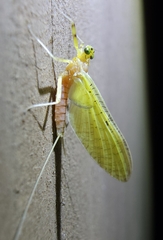
The March brown mayfly (Rhithrogena germanica) is a European mayfly whose aquatic larvae live on river bottoms and emerge very early in the year, from late winter to early April. Adults and subimagos have two long tail filaments and clearly visible hind wings, and the subimago stage can last up to four days before the final molt. It can be told apart from the only other UK Rhithrogena species by a dark spot on the femora of its legs.
Source: Wikipedia
How to recognize it
A dark spot on the femur of each leg distinguishes Rhithrogena germanica from the similar Rhithrogena semicolorata.
Source: Wikipedia
Size
Both adult and subimago stages have two long tail filaments and noticeable hind wings.
Source: Wikipedia
Where it lives
The nymphs live on the bottoms of rivers, staying fully aquatic.
Source: Wikipedia
Life cycle
Nymphs emerge very early, at the end of winter or in early spring (March to early April). The subimago appears at the end of winter and can remain for up to four days before becoming the adult imago.
Source: Wikipedia
When you see it
Subimagos are seen at the end of winter, while the larvae appear from March to early April.
Source: Wikipedia
Where it comes from
Rhithrogena germanica is native to Europe.
Source: Wikipedia
Lookalikes
Ecdyonurus venosus, the false March brown, looks similar but emerges later in the year. Rhithrogena semicolorata is the only other UK Rhithrogena species and lacks the dark femoral spot.
Source: Wikipedia
More photos


Questions people ask
How can I tell the March brown mayfly apart from other similar species?
Look for a dark spot on the femur of each leg; this spot is present in Rhithrogena germanica but not in Rhithrogena semicolorata.
Source: Wikipedia
When do March brown mayflies appear?
The nymphs emerge at the end of winter and into early spring (March to early April), and the subimago stage shows up at the end of winter.
Source: Wikipedia
What does the subimago stage look like?
Both subimago and adult have two long tail filaments and clearly visible hind wings, and the subimago can last up to four days before molting.
Source: Wikipedia
Same family (Heptageniidae)


Sources
- Wikipedia: https://en.wikipedia.org/wiki/Rhithrogena_germanica
Look it up elsewhere: GBIF · iNaturalist · BugGuide · Wikipedia
Text written 2026-10-23 from the sources above and checked sentence by sentence against them. Data fetched 2026-10-23.