 Bug FAQ
Lesser House Fly
Fannia canicularis · Order: Diptera · Family: Fanniidae
Also called: Little House Fly
Source: Wikipedia
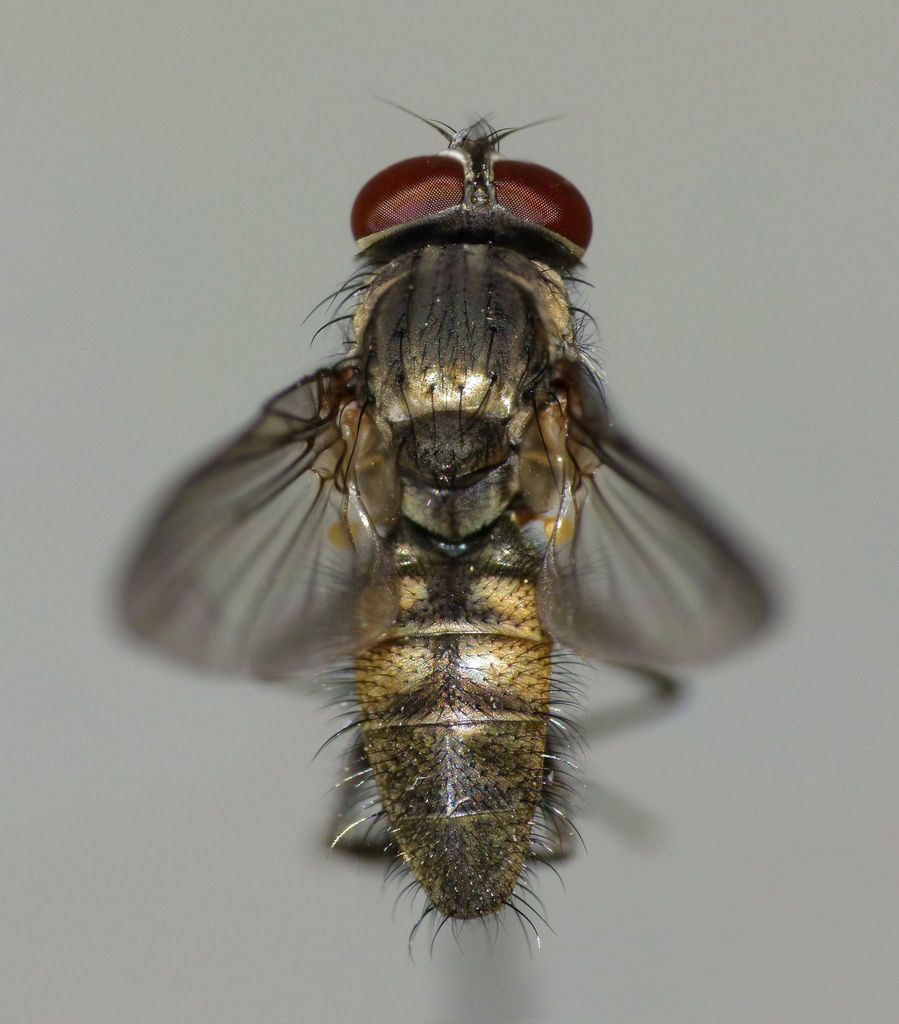
The lesser house fly is a small, 4-6 mm fly with distinctive black stripes on the male thorax and yellow-tinged abdomen segments. It lives worldwide, breeds in decaying organic matter and excrement, and adults can be found year-round except in February, sometimes disappearing in hot summers. Females lay up to 2 000 eggs in batches of about 50; eggs hatch in two days, larvae develop in a week, and the whole life cycle lasts two to three weeks.
Source: Wikipedia
How to recognize it
Males have three black longitudinal stripes on a brown-grey thorax. The first two abdominal segments appear translucent yellow with a dark brown base.
Source: Wikipedia
Size
Adults measure about 4 to 6 mm in length, slightly smaller than a common housefly.
Source: Wikipedia
Is it a pest in the house?
They often enter buildings and can be noticed by their silent, hovering flight in the middle of rooms. They are frequently found near garbage containers, waste depots, and garbage trucks.
Source: Wikipedia
Does it bite or sting?
They are considered possible disease carriers because they move between waste and food. They have been reported as vectors of the eye worm Thelazia californiensis.
Source: Wikipedia
How to get rid of it
Females lay eggs in batches up to 50, with a total potential of about 2 000 eggs. Eggs hatch in two days at warm temperatures, larvae need at least six days to pupate, and pupation lasts a week or more.
Source: Wikipedia
Where it lives
They are commonly seen on animal waste, excrement, and on vertebrate animals themselves. Outside, they gather on sheltered trees away from wind and direct sun for their swarming dances.
Source: Wikipedia
What it eats
Larvae feed on decaying organic material, including carrion. Because they move between waste and human food, they can act as disease vectors.
Source: Wikipedia
Life cycle
Adults live for two to three weeks. In Central Europe, roughly seven generations can develop each year.
Source: Wikipedia
When you see it
Adults are present all year in Massachusetts except February, but may disappear during very hot summers.
Source: Wikipedia
Where it comes from
The species is found worldwide.
Source: Wikipedia
Lookalikes
Although they look similar to house flies, they are not closely related within the order Diptera.
Source: Wikipedia
Where it is found in the US
Recorded in 27 of 51 states and DC. Most records: California, Alaska, Massachusetts, Pennsylvania, Kansas, Oklahoma, Arizona, Texas.
Darker = more records. Counts are museum and citizen-science records, not population size.
Source: GBIF
Months it is reported in the US
Source: GBIF
More photos
Questions people ask
Do lesser house flies bite or sting?
They are considered possible disease carriers because they go back and forth between droppings and human food. They also carry a parasitic eye worm.
Source: Wikipedia
How can I identify a lesser house fly?
Look for a small 4-6 mm fly with three black stripes on the male thorax and yellow-tinged first abdominal segments.
Source: Wikipedia
Where are these flies most likely to be found?
They are common on animal waste, excrement, and near garbage containers, and outdoors on sheltered trees for swarming.
Source: Wikipedia
What is their life cycle length?
From egg to adult takes about two weeks, and adults live another two to three weeks.
Source: Wikipedia
Sources
- Wikipedia: https://en.wikipedia.org/wiki/Lesser_house_fly
Look it up elsewhere: GBIF · iNaturalist · BugGuide · ITIS · Wikipedia
Text written 2026-10-22 from the sources above and checked sentence by sentence against them. Data fetched 2026-10-22.