 Bug FAQ
Laricobius nigrinus
Laricobius nigrinus · Order: Coleoptera · Family: Derodontidae
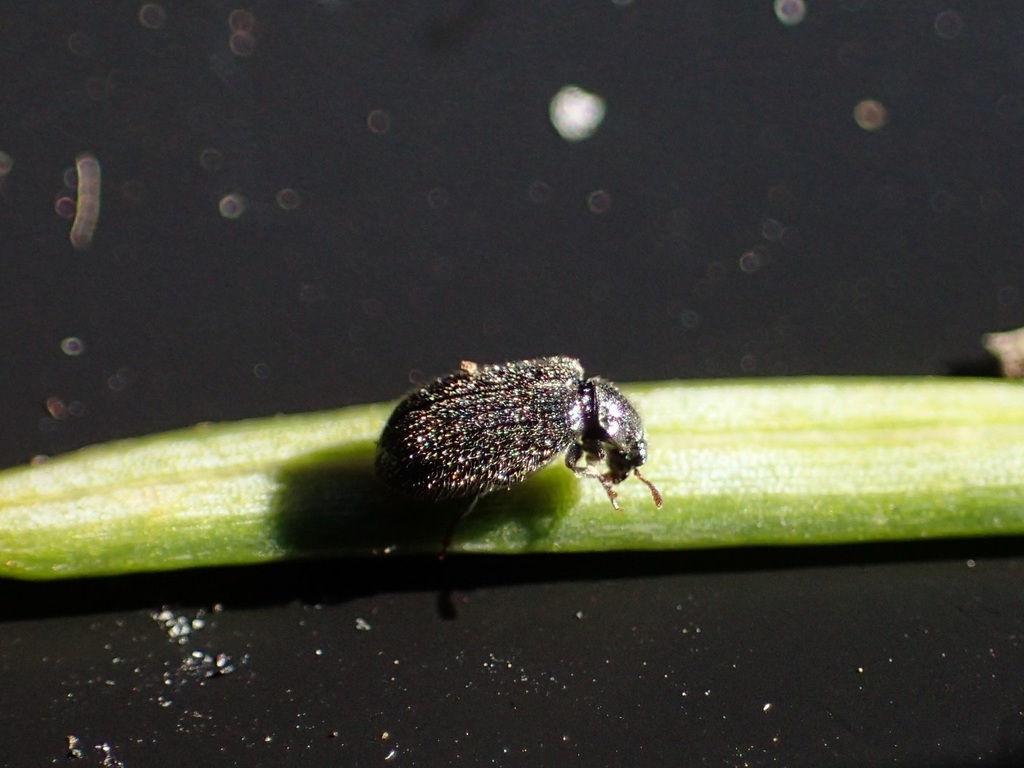
Laricobius nigrinus is a tiny black beetle about 2.5 mm long that lives in western North American hemlock forests. It feeds only on the hemlock woolly adelgid, laying eggs in early spring and completing one generation each year. Because it attacks this invasive pest, it has been released as a biological control agent since 2003.
Source: Wikipedia
How to recognize it
Adults have a black body, club-shaped antennae with eleven segments, and two simple eyes. A distinctive toothed edge on the pronotum sets it apart from other black Laricobius species.
Source: Wikipedia
Size
They measure roughly 2.3 to 2.9 mm in length, with males and females the same size.
Source: Wikipedia
How to get rid of it
Field releases began in 2003 and the beetle has since spread across many infested areas.
Source: Wikipedia
Where it lives
You’ll find it throughout the western United States and Canada, even up into the southeastern Yukon. Its natural home is hemlock forests of the Pacific Northwest.
Source: Wikipedia
What it eats
Both adults and larvae eat the hemlock woolly adelgid; adults take the adult insects, while larvae consume the eggs of the spring generation.
Source: Wikipedia
Life cycle
The beetle has one generation per year and passes through four larval stages.
Source: Wikipedia
When you see it
Eggs are laid in early spring, timed to match the winter/spring adelgid generation. Adults are far more active during daylight than at night.
Source: Wikipedia
Where it comes from
It is native to western North America. Its range includes the western U.S., Canada, and reaches as far north as the southeastern Yukon.
Source: Wikipedia
Lookalikes
It can be confused with other black Laricobius beetles, but the toothed pronotal margin is a reliable difference.
Source: Wikipedia
Where it is found in the US
Recorded in 17 of 51 states and DC. Most records: Georgia, Virginia, North Carolina, Idaho, New Jersey, Tennessee, Washington, Oregon.
Darker = more records. Counts are museum and citizen-science records, not population size.
Source: GBIF
Status: native in North America; native in Canada. Source: iNaturalist
Months it is reported in the US
Source: GBIF
More photos
Questions people ask
What does Laricobius nigrinus look like?
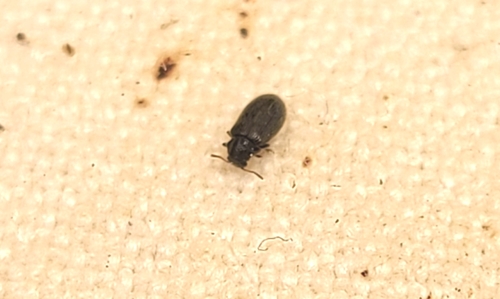
It is a small black beetle about 2.5 mm long with club-shaped antennae, two simple eyes, and a toothed edge on the pronotum.
Source: Wikipedia
Where can I find this beetle?
It lives in hemlock forests of the Pacific Northwest and is found throughout the western United States, Canada, and up into the southeastern Yukon.
Source: Wikipedia
What does it eat?
Both adults and larvae feed exclusively on the hemlock woolly adelgid, with larvae eating the eggs of the spring generation.
Source: Wikipedia
Is it used for pest control?
Yes, it was approved in 2000 and released starting in 2003 to control hemlock woolly adelgid infestations.
Source: Wikipedia
Sources
- Wikipedia: https://en.wikipedia.org/wiki/Laricobius_nigrinus
Look it up elsewhere: GBIF · iNaturalist · BugGuide · ITIS · Wikipedia
Text written 2026-10-23 from the sources above and checked sentence by sentence against them. Data fetched 2026-10-23.