 Bug FAQ
House Psocid
Liposcelis bostrychophila · Order: Psocodea · Family: Liposcelididae
Also called: Bark lice
Source: Wikipedia, Penn State Extension
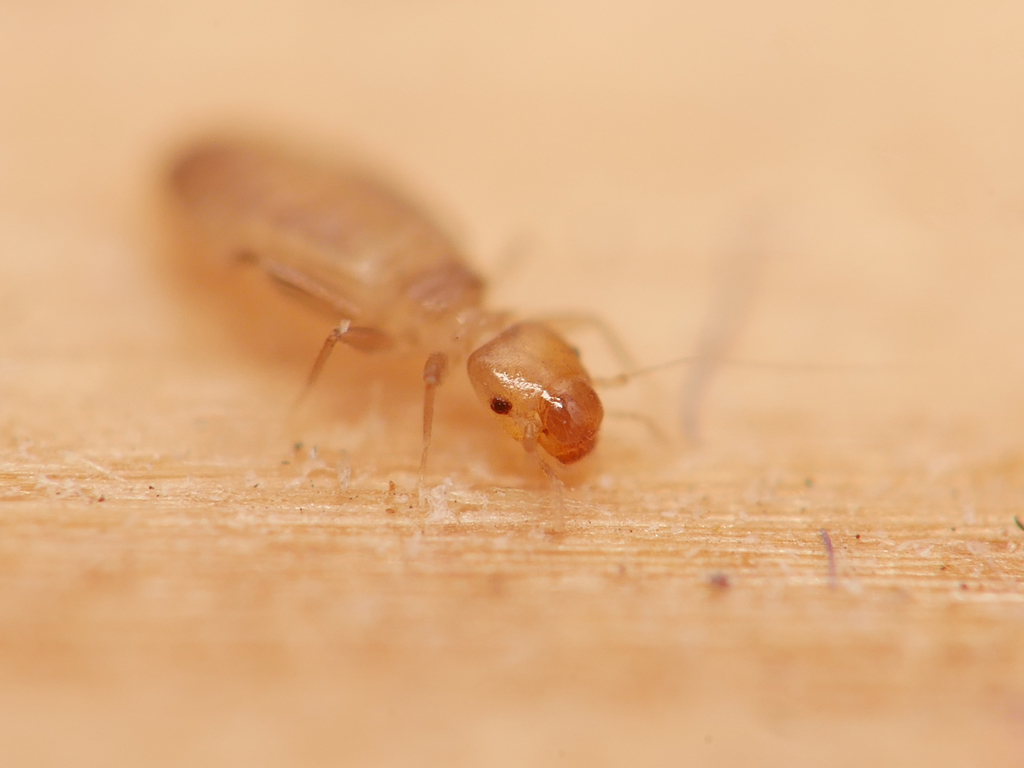
The house psocid is a tiny, wing-less insect about 1 mm long, pale brown to dark tan in color. It lives worldwide in dry food stores, warehouses and humid indoor areas where it feeds on mold, fungi and stored cereals. Females reproduce mainly by parthenogenesis, laying about 200 eggs that develop into nymphs over roughly 40 days, and they can survive up to two months without food.
Source: Wikipedia, Penn State Extension
How to recognize it
It is about 1 mm long, brown, and has no wings. Color ranges from light tan to dark brown, sometimes grey or nearly clear in young ones.
Source: Wikipedia, Penn State Extension
Size
Adults measure roughly 1 mm (0.04 in) in length.
Source: Wikipedia
Is it a pest in the house?
A major stored-product pest because it reproduces quickly and resists chemicals. Infests humid indoor areas and feeds on mold, paper, books, wallpaper, flour and grains.
Source: Wikipedia, Penn State Extension
Does it bite or sting?
It does not bite or sting and does not spread disease.
Source: Penn State Extension
How to get rid of it
Chemical pesticides are problematic in food settings due to toxicity and resistance. The best control is to fix moisture problems; keeping humidity below 50 % stops mold and booklouse growth.
Source: Wikipedia, Penn State Extension
Where it lives
Found worldwide in grain stores, warehouses, factories and homes where dry food is kept. Also lives in damp, dark indoor spots that support mold growth.
Source: Wikipedia, Penn State Extension
What it eats
Feeds mainly on fungi, mold and cereals.
Source: Wikipedia
Life cycle
Females mostly reproduce without males, producing about 200 eggs each. Eggs hatch to nymphs that molt four times and become adults in about 40 days.
Source: Wikipedia
When you see it
Can enter diapause and survive up to two months without food. Sexually reproducing strains have been found in Hawaii (2002) and Arizona (2009).
Source: Wikipedia
Where it comes from
It has a worldwide distribution as a common stored-product pest.
Source: Wikipedia
Lookalikes
Because of its flat shape it can be mistaken for bedbugs, but bedbugs are larger and rounder.
Source: Penn State Extension
Where it is found in the US
Recorded in 4 of 51 states and DC. Most records: California, Illinois, Indiana, Alabama.
Darker = more records. Counts are museum and citizen-science records, not population size.
Source: GBIF
Months it is reported in the US
Source: GBIF
Questions people ask
Do house psocids bite?
No, they do not bite or sting and are not disease vectors.
Source: Penn State Extension
How can I get rid of them?
Reduce humidity below 50 % with dehumidifiers or moisture absorbers and eliminate moldy food sources.
Source: Penn State Extension
What damage do they cause?
They can damage stored grains, flour, paper, books, wallpaper and other humid indoor items.
Source: Wikipedia, Penn State Extension
Same family (Liposcelididae)

Sources
- Wikipedia: https://en.wikipedia.org/wiki/Liposcelis_bostrychophila
- Penn State Extension: https://extension.psu.edu/booklice
Look it up elsewhere: GBIF · iNaturalist · BugGuide · ITIS · Wikipedia
Text written 2026-10-22 from the sources above and checked sentence by sentence against them. Data fetched 2026-10-22.