 Bug FAQ
Hemlock Woolly Adelgid
Adelges tsugae · Order: Hemiptera · Family: Adelgidae
Source: Wikipedia
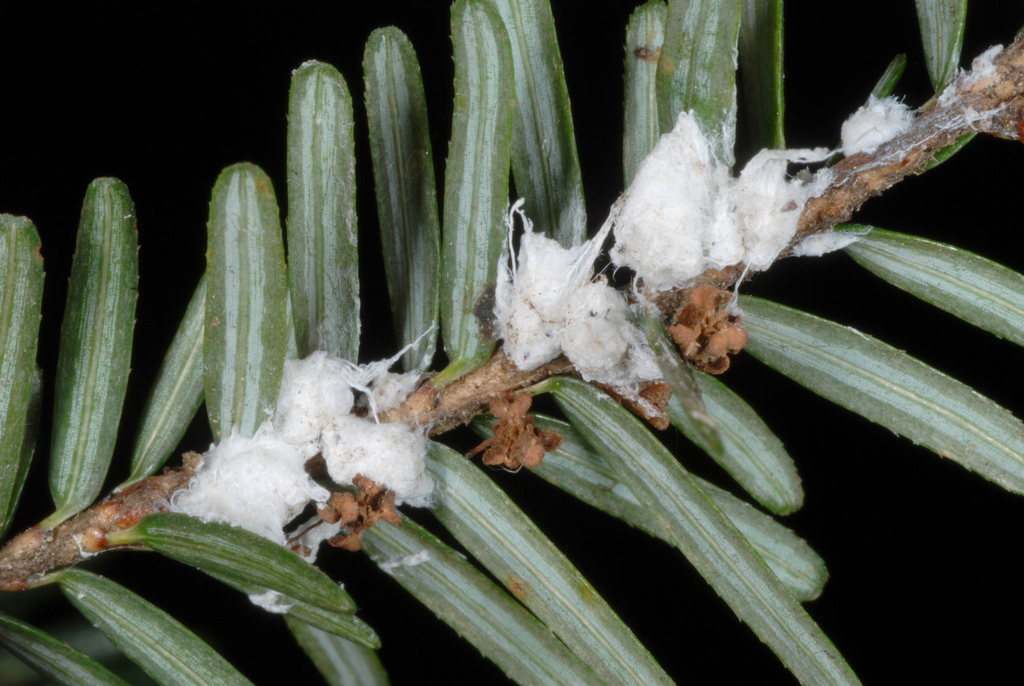
The adult adelgid is a tiny oval bug about 0.8 mm long with a bundle of four brown stylets used for feeding. It lives on hemlock and spruce, reproduces asexually with two all-female generations per year, and spreads in spring by wind, birds or mammals. Control methods include the predatory beetle Sasajiscymnus tsugae and systemic insecticides that can protect trees for several years.
Source: Wikipedia
How to recognize it
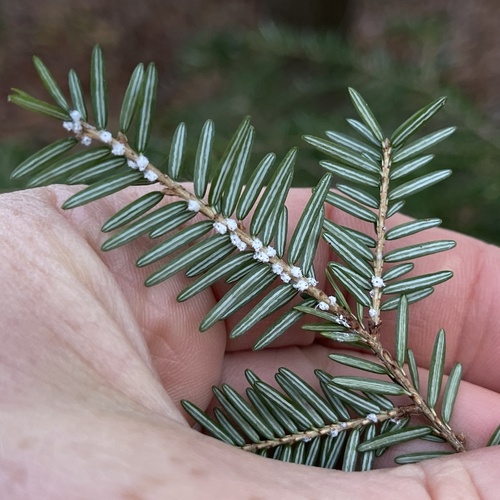
The insect is brown and has four thread-like stylets that work together as its mouthpart. Egg sacs look like tiny tufts of cotton hanging under branches.
Source: Wikipedia
Size
Adults are about 0.8 mm long and oval shaped.
Source: Wikipedia
Is it a pest in the house?
Feeding causes the tree to dry out, lose needles and stop producing new growth.
Source: Wikipedia
How to get rid of it
A leading biological control is the predatory beetle Sasajiscymnus tsugae. Systemic insecticides applied to foliage and bark can remain effective for up to four years.
Source: Wikipedia
Where it lives
It feeds on the sap of hemlock and spruce trees. In western North America it mainly attacks western hemlock and damage is limited by predators and host resistance.
Source: Wikipedia
What it eats
It pierces the tree’s parenchyma with a stylet bundle three times its body length to draw nutrients from stored reserves.
Source: Wikipedia
Life cycle
In North America it reproduces asexually, producing two generations each year. Both generations are parthenogenetic and consist only of females.
Source: Wikipedia
When you see it
Larvae emerge in spring and can be spread by wind, birds or mammals. Nymphs are immobile and stay on a single tree.
Source: Wikipedia
Where it comes from
The species comes from East Asia and belongs to the true-bug order Hemiptera. In its Asian range a third, winged generation called sexupera occurs.
Source: Wikipedia
Where it is found in the US
Recorded in 28 of 51 states and DC. Most records: Massachusetts, New York, Pennsylvania, North Carolina, New Hampshire, Tennessee, Virginia, Connecticut.
Darker = more records. Counts are museum and citizen-science records, not population size.
Source: GBIF
Status: introduced in United States. Source: iNaturalist
Months it is reported in the US
Source: GBIF
More photos


Questions people ask
How can I tell if my tree has Hemlock woolly adelgid?
Look for tiny cotton-like egg sacs on the underside of branches and for signs of needle loss and dieback.
Source: Wikipedia
What can I do to control an infestation?
Introduce the predatory beetle Sasajiscymnus tsugae or apply a systemic insecticide that can protect the tree for several years.
Source: Wikipedia
Sources
- Wikipedia: https://en.wikipedia.org/wiki/Hemlock_woolly_adelgid
Look it up elsewhere: GBIF · iNaturalist · BugGuide · Wikipedia
Text written 2026-10-22 from the sources above and checked sentence by sentence against them. Data fetched 2026-10-22.