 Bug FAQ
Giant red-winged grasshopper
Tropidacris cristata · Order: Orthoptera · Family: Romaleidae
Source: Wikipedia
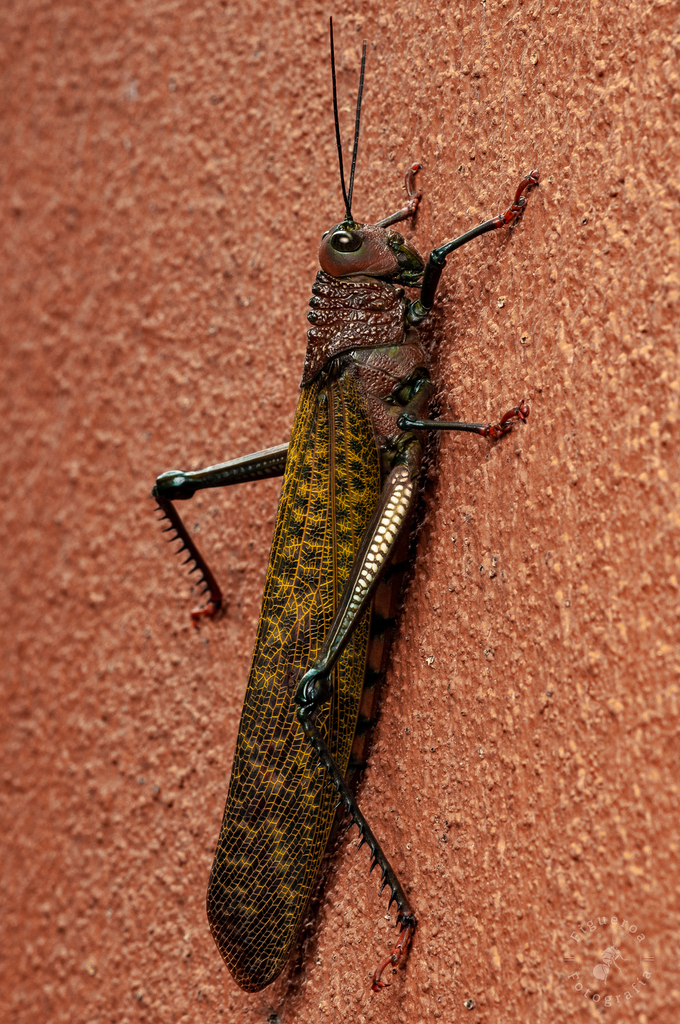
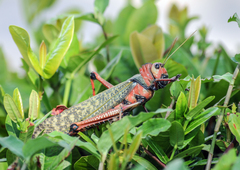
The giant red-winged grasshopper is one of the largest grasshoppers, with adults up to 14.5 cm long and a wingspan of 24 cm. Adults have bright red wings in flight, while the young have warning black-and-yellow stripes and are thought to be toxic. It lives in a variety of habitats from humid forests to drier areas, eats many plants, and can become a pest in gardens and farms.
Source: Wikipedia
How to recognize it
Adults show conspicuous red wings when they fly; the exact shade varies. Nymphs are flightless, gregarious, and display dark-and-yellow stripes that warn predators.
Source: Wikipedia
Size
Maximum length is about 14.5 cm and wingspan can reach 24 cm. Typical adult males are 5.5 to 7 cm long (average 6.5 cm) and females 7 to 12 cm (average 11 cm).
Source: Wikipedia
Is it a pest in the house?
Occasionally regarded as a pest because it feeds on many plant types.
Source: Wikipedia
Where it lives
Found in many habitats, from lowland to highland areas. In the southern part of its range it prefers humid or semi-humid forests and avoids dry open places; farther north it also occurs in somewhat drier sites.
Source: Wikipedia
What it eats
Feeds on a wide variety of plants and is sometimes considered a pest.
Source: Wikipedia
Life cycle
Females lay an egg sac in the soil containing up to 100 eggs. The species has an annual life cycle with overlapping generations, though adult and nymph occurrence can be seasonal in some regions.
Source: Wikipedia
When you see it
Adult and nymph numbers may show seasonal patterns depending on the region.
Source: Wikipedia
Lookalikes
The blue-winged Tropidacris collaris often overlaps in range, but only T. cristata occurs in parts of northwestern South America and Central America.
Source: Wikipedia
Status: native in North America. Source: iNaturalist
More photos

Questions people ask
Can it damage my garden?
Yes, it can chew leaves of garden plants and crops, sometimes becoming a pest.
Source: Wikipedia
Same family (Romaleidae)
Sources
- Wikipedia: https://en.wikipedia.org/wiki/Tropidacris_cristata
Look it up elsewhere: GBIF · iNaturalist · BugGuide · Wikipedia
Text written 2026-10-22 from the sources above and checked sentence by sentence against them. Data fetched 2026-10-22.