 Bug FAQ
Forest Malachite
Chlorolestes tessellatus · Order: Odonata · Family: Synlestidae

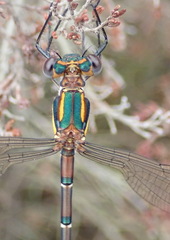
Both sexes have a metallic-green body that turns coppery brown with broad yellow stripes on the thorax. It lives in shady forest streams and seeps and is found only in South Africa.
Source: Wikipedia
How to recognize it
Males and females look alike, with a metallic-green to coppery brown thorax and abdomen. The thorax shows wide yellow antehumeral stripes, broader than those of the similar Mountain Malachite.
Source: Wikipedia
Size
Body length ranges from 47 to 57 mm and wingspan from 55 to 72 mm.
Source: Wikipedia
Where it lives
It prefers shaded habitats such as forest streams, seeps, and wooded valleys.
Source: Wikipedia
Where it comes from
The species is endemic to South Africa.
Source: Wikipedia
Lookalikes
Its yellow thorax stripes are broader than those of the Mountain Malachite, a common look-alike.
Source: Wikipedia
More photos


Questions people ask
How can I identify a Forest Malachite?
Look for a metallic-green to coppery brown body about 5 cm long with wide yellow stripes on the thorax; both sexes look the same.
Source: Wikipedia
Where does the Forest Malachite live?
It lives in shady forest streams and seeps in South Africa.
Source: Wikipedia
Same family (Synlestidae)




Sources
- Wikipedia: https://en.wikipedia.org/wiki/Chlorolestes_tessellatus
Look it up elsewhere: GBIF · iNaturalist · BugGuide · Wikipedia
Text written 2026-10-23 from the sources above and checked sentence by sentence against them. Data fetched 2026-10-23.