 Bug FAQ
Empis tessellata
Empis tessellata · Order: Diptera · Family: Empididae
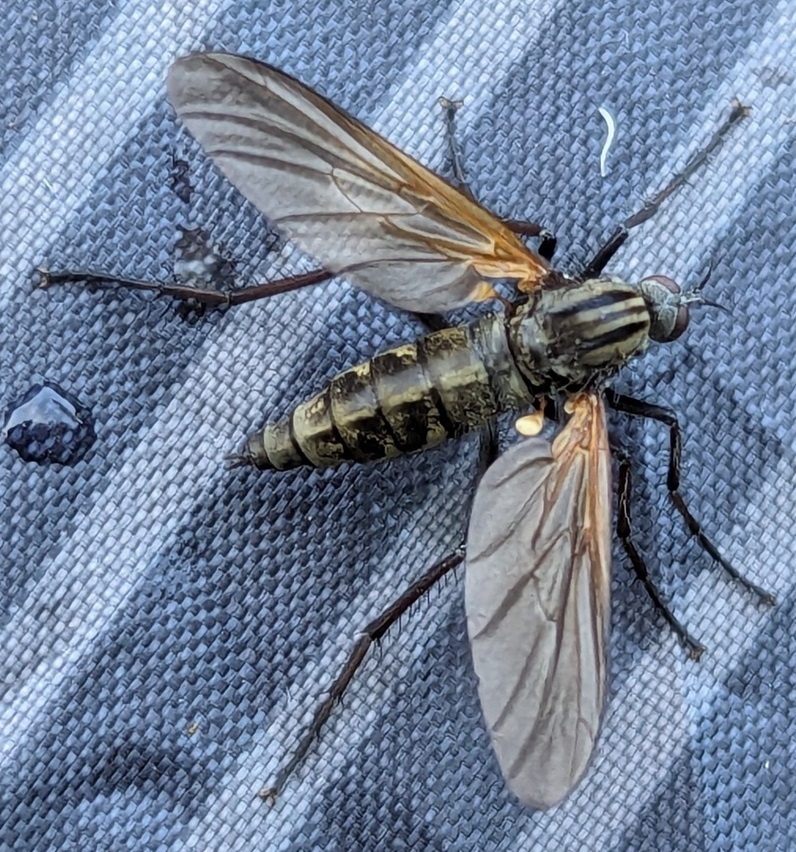
Empis tessellata is a large dance fly about 9 to 11 mm long with a wingspan of similar size. It has a black bristly body, red-yellow legs with black thighs, gray-black thorax with three stripes, and a bronze-gray marbled abdomen. Adults appear from April to August, hunt small insects, and also sip flower nectar.
Source: Wikipedia
How to recognize it
The fly’s body is strongly black and bristly. Legs are usually red-yellow with black thighs. Wings are brown-tinged with dark veins and a rusty-yellow edge. Thorax is gray-black with three longitudinal black stripes. Abdomen is elongated, arched, and bronze-gray marbled.
Source: Wikipedia
Size
Length about 9 to 11 mm; wingspan roughly the same.
Source: Wikipedia
Where it lives
Found on plants in moist meadows, forest edges, clearings, and lightly wooded spots.
Source: Wikipedia
What it eats
Adults mainly catch other small insects, especially flies, and also feed on flower nectar. Male adults are predatory, and larvae also hunt prey.
Source: Wikipedia
Life cycle
Creamy-yellow larvae live underground and in leaf litter.
Source: Wikipedia
When you see it
Adults are active from April through August.
Source: Wikipedia
Where it comes from
Distributed across most of Europe, from the Mediterranean up to Scandinavia, and eastward to the Middle East, Central Asia, and Japan.
Source: Wikipedia
Lookalikes
It is the largest Empis species in Britain, though similar-sized species exist in mainland Europe.
Source: Wikipedia
Questions people ask
Are they a garden pest?
They hunt other small insects and also visit flowers for nectar, but no source says they damage plants.
Source: Wikipedia
Sources
- Wikipedia: https://en.wikipedia.org/wiki/Empis_tessellata
Look it up elsewhere: GBIF · iNaturalist · BugGuide · Wikipedia
Text written 2026-10-22 from the sources above and checked sentence by sentence against them. Data fetched 2026-10-22.