 Bug FAQ
Elm Seed Bug
Arocatus melanocephalus · Order: Hemiptera · Family: Lygaeidae
Also called: Lygaeid bug
Source: Wikipedia

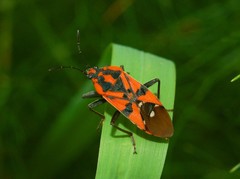
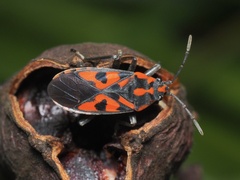
Adult Elm Seed Bugs are about 8 mm long and have a dark red, hairy body with a black head and a distinctive M-shaped spot on the pronotum. They are commonly found on elm, sycamore, poplar, oak and alder trees, and they have been entering buildings in northern Italy since 1999, with infestations lasting from late May to September.
Source: Wikipedia
How to recognize it
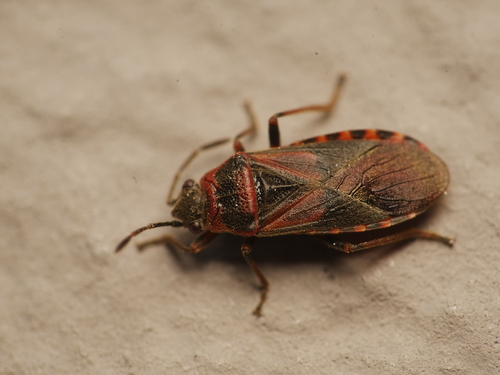
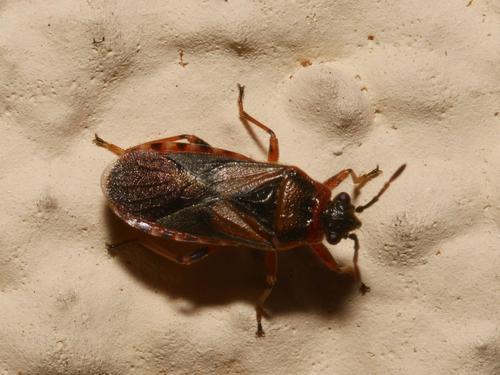
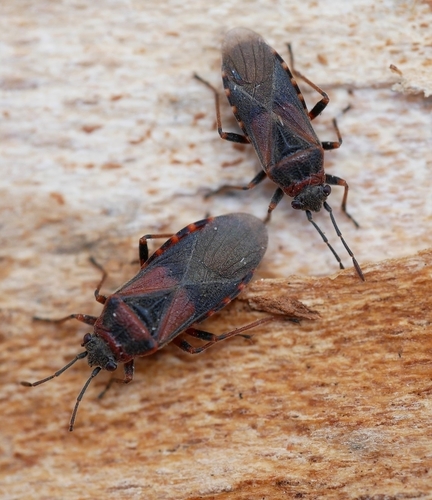
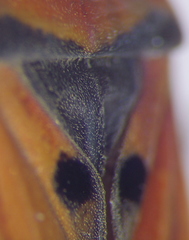
The bug’s body is dark red and covered in short hairs; the head and most of the antennae are black, though the last two antennal segments can be partly red. The pronotum bears a characteristic M-shaped spot, and the underside of the abdomen is orange.
Source: Wikipedia
Is it a pest in the house?
Elm Seed Bugs have been entering and establishing themselves in buildings in northern Italy since 1999 and were introduced to North America in the 2000s.
Source: Wikipedia
How to get rid of it
The insecticide etofenprox works against Elm Seed Bugs, while pyrethrum and rotenone are ineffective.
Source: Wikipedia
Where it lives
They live on various trees such as elm, old-world sycamore, poplar, oak and alder, and can also be found inside empty butterfly pupae. Since 1999 they have been recorded inside buildings in northern Italian cities.
Source: Wikipedia
What it eats
It feeds on the leaves and seeds of elm, sycamore, poplar, oak and alder trees, and can be found in empty butterfly pupae.
Source: Wikipedia
Life cycle
The species was first described by Johan Christian Fabricius in 1798. Unlike many related bugs, it stores less than 7 % of certain cardenolides after feeding on them.
Source: Wikipedia
When you see it
Infestations occur in summer, typically from late May or early June through late September.
Source: Wikipedia
Where it comes from
The species is native to Europe and also occurs in parts of Asia including Armenia, Azerbaijan, Georgia, Turkey, China and Iran.
Source: Wikipedia
Lookalikes
A phylogenetic study groups this bug with A. longiceps, another species that cannot store cardenolides.
Source: Wikipedia
Where it is found in the US
Recorded in 15 of 51 states and DC. Most records: Utah, New Mexico, Oregon, Idaho, Washington, Colorado, Michigan, Nevada.
Darker = more records. Counts are museum and citizen-science records, not population size.
Source: GBIF
Status: introduced in North America; introduced in United States. Source: iNaturalist
Months it is reported in the US
Source: GBIF
More photos
Questions people ask
How can I get rid of Elm Seed Bugs?
Use an insecticide containing etofenprox, as it has been shown to be effective against this species.
Source: Wikipedia
When do Elm Seed Bugs appear?
They are most common from late May or early June until late September.
Source: Wikipedia
What do Elm Seed Bugs look like?
Adults are about 8 mm long, dark red and hairy, with a black head, black-mostly antennae, an orange underside, and an M-shaped spot on the pronotum.
Source: Wikipedia
Where are Elm Seed Bugs found?
They live on elm, sycamore, poplar, oak and alder trees and have been found inside buildings in northern Italy and parts of North America.
Source: Wikipedia
Same family (Lygaeidae)


Sources
- Wikipedia: https://en.wikipedia.org/wiki/Arocatus_melanocephalus
Look it up elsewhere: GBIF · iNaturalist · BugGuide · Wikipedia
Text written 2026-10-23 from the sources above and checked sentence by sentence against them. Data fetched 2026-10-22.