 Bug FAQ
Eastern Sycamore Lace Bug
Corythucha ciliata · Order: Hemiptera · Family: Tingidae
Also called: Plane lace bug, Sycomore lace bug, sycamore lace bug
Source: Wikipedia

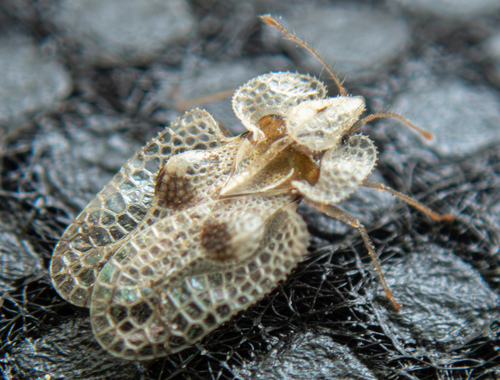
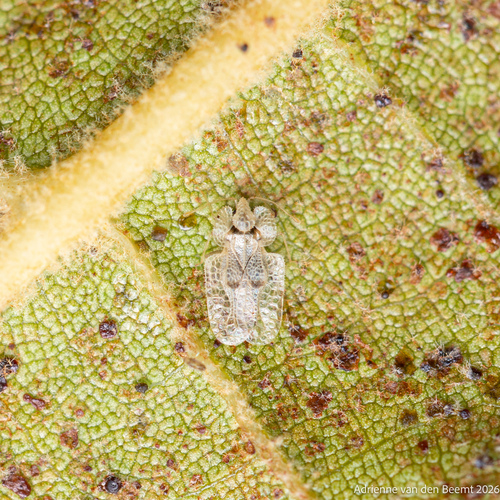
The adult Eastern Sycamore Lace Bug is a small, milky-white insect about 3.2 to 3.7 mm long. It lives on the undersides of sycamore leaves, feeding on sap and leaving tiny black frass mounds and shed skins.
Source: Wikipedia
How to recognize it
It lacks the brown crescent band seen on the cotton lace bug and is larger than the Florida oak lace bug, with only a tiny brown spot on each wing case.
Source: Wikipedia
Size
Adults measure between 3.2 and 3.7 mm in length.
Source: Wikipedia
Is it a pest in the house?
In Europe the bug has been reported landing on people and biting them, sometimes causing skin reactions.
Source: Wikipedia
Does it bite or sting?
Bites have been noted in Italy, France and Romania, with some people developing dermatosis.
Source: Wikipedia
Where it lives
The bug stays on the leaf underside, sucking sap and producing black dried frass piles.
Source: Wikipedia
What it eats
It pierces leaf epidermis with its mouthparts to extract sap.
Source: Wikipedia
Life cycle
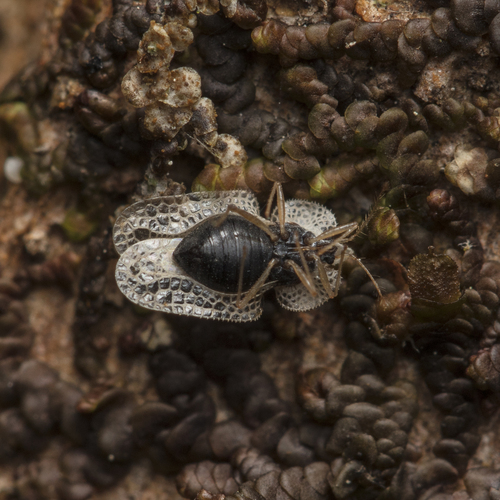
Nymphs pass through five instars before becoming adults via incomplete metamorphosis. In warm areas the whole cycle can finish in about 44 days, allowing one to three generations per year.
Source: Wikipedia
When you see it
Adults overwinter in bark crevices or under bark flakes and can survive temperatures down to to 24 °C.
Source: Wikipedia
Where it comes from
It originates from North America and occurs wherever its host sycamore trees grow.
Source: Wikipedia
Lookalikes
It resembles the cotton lace bug and Florida oak lace bug but can be distinguished by the absence of a brown crescent band and its larger size.
Source: Wikipedia
Where it is found in the US
Recorded in 36 of 51 states and DC. Most records: Maryland, Illinois, Kentucky, Mississippi, Ohio, Virginia, Kansas, Pennsylvania.
Darker = more records. Counts are museum and citizen-science records, not population size.
Source: GBIF
Months it is reported in the US
Source: GBIF
More photos

Questions people ask
Do Eastern Sycamore Lace Bugs bite people?
Yes, they have been reported biting humans and causing skin irritation such as dermatosis.
Source: Wikipedia
What do these bugs look like?
Adults are milky-white, about 3.2 to 3.7 mm long, with a tiny brown spot on each wing case and no brown crescent band.
Source: Wikipedia
Where are they found?
They are native to North America and live on the undersides of sycamore leaves, feeding on sap.
Source: Wikipedia
Same family (Tingidae)
Sources
- Wikipedia: https://en.wikipedia.org/wiki/Corythucha_ciliata
Look it up elsewhere: GBIF · iNaturalist · BugGuide · ITIS · Wikipedia
Text written 2026-10-22 from the sources above and checked sentence by sentence against them. Data fetched 2026-10-22.