 Bug FAQ
Eastern Dobsonfly
Corydalus cornutus · Order: Megaloptera · Family: Corydalidae
Also called: dobsonfly
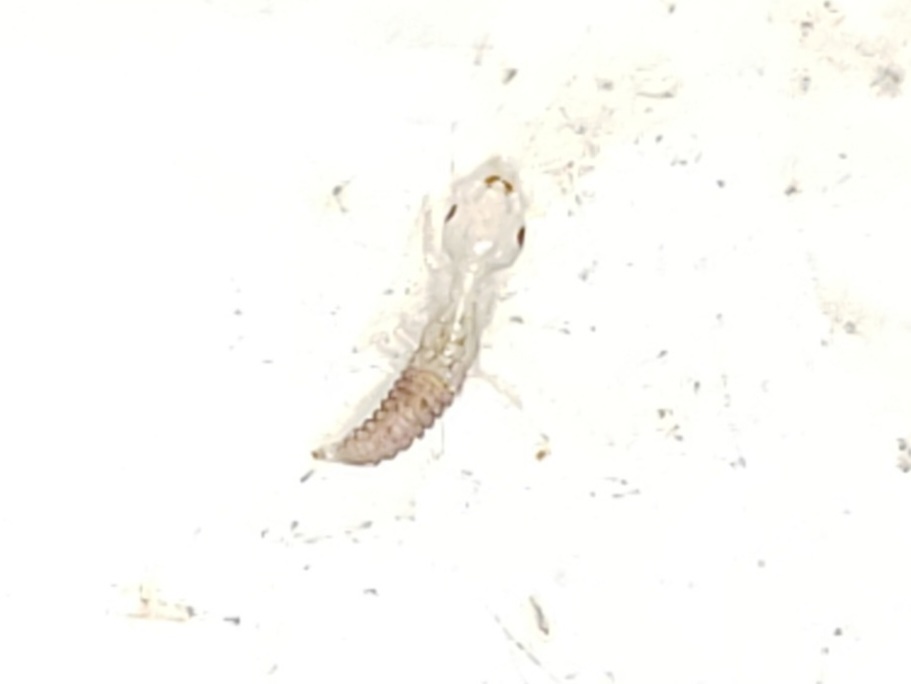
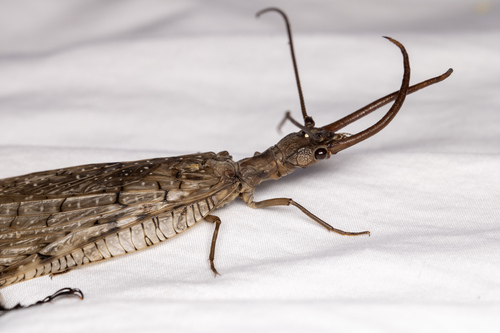
Adult eastern dobsonflies are large insects up to about 140 mm long with a wingspan near 130 mm and have translucent, many-veined wings that often show white spots. They live near clean, fast-flowing streams in eastern North America, where the larvae hide under stones and eat soft-bodied invertebrates, while adults do not feed and stay in dense vegetation close to the water. Adults are nocturnal, attracted to lights, and emerge after a pupal stage that can last from a week to overwintering, with the whole life cycle taking one to three years.
Source: Wikipedia
How to recognize it
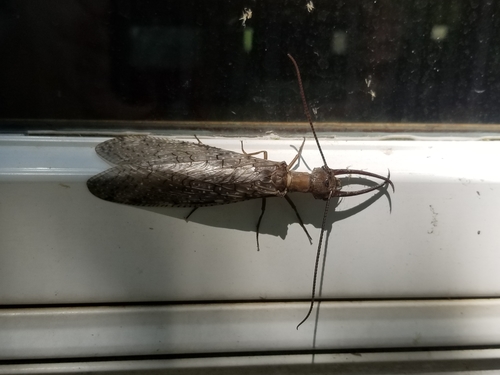
Males have long, sickle-shaped jaws about 40 mm, while females have short, strong jaws similar in size to those of the larvae.
Source: Wikipedia
Size
The insect can grow to roughly 140 mm in length with a wingspan of about 130 mm.
Source: Wikipedia
Where it lives
They are typically found beside swift, clean streams where the larvae develop underwater. Larvae hide under rocks and prey on soft-bodied invertebrates.
Source: Wikipedia
Life cycle
Females lay eggs near water on rocks or foliage, and the eggs hatch at night after one to two weeks. After one to three years, mature larvae leave the water, crawl up to fifteen metres, and look for a sheltered spot to pupate under debris.
Source: Wikipedia
When you see it
Adults are most active at night and are drawn to artificial lights. In some regions they emerge within a week to two weeks, while in others they remain as pupae through the winter.
Source: Wikipedia
Where it comes from
The species occurs throughout most of eastern North America.
Source: Wikipedia
Where it is found in the US
Recorded in 40 of 51 states and DC. Most records: Virginia, Texas, North Carolina, Pennsylvania, Maryland, Alabama, Georgia, Tennessee.
Darker = more records. Counts are museum and citizen-science records, not population size.
Source: GBIF
Status: native in North America; native in Canada. Source: iNaturalist
Months it is reported in the US
Source: GBIF
More photos
Questions people ask
Where can I find them?
Look near clean, fast-moving streams in eastern North America, especially at night near lights.
Source: Wikipedia
Same family (Corydalidae)


Sources
- Wikipedia: https://en.wikipedia.org/wiki/Corydalus_cornutus
Look it up elsewhere: GBIF · iNaturalist · BugGuide · ITIS · Wikipedia
Text written 2026-10-22 from the sources above and checked sentence by sentence against them. Data fetched 2026-10-22.