 Bug FAQ
Desert Recluse
Loxosceles deserta · Order: Araneae · Family: Sicariidae
Source: Wikipedia
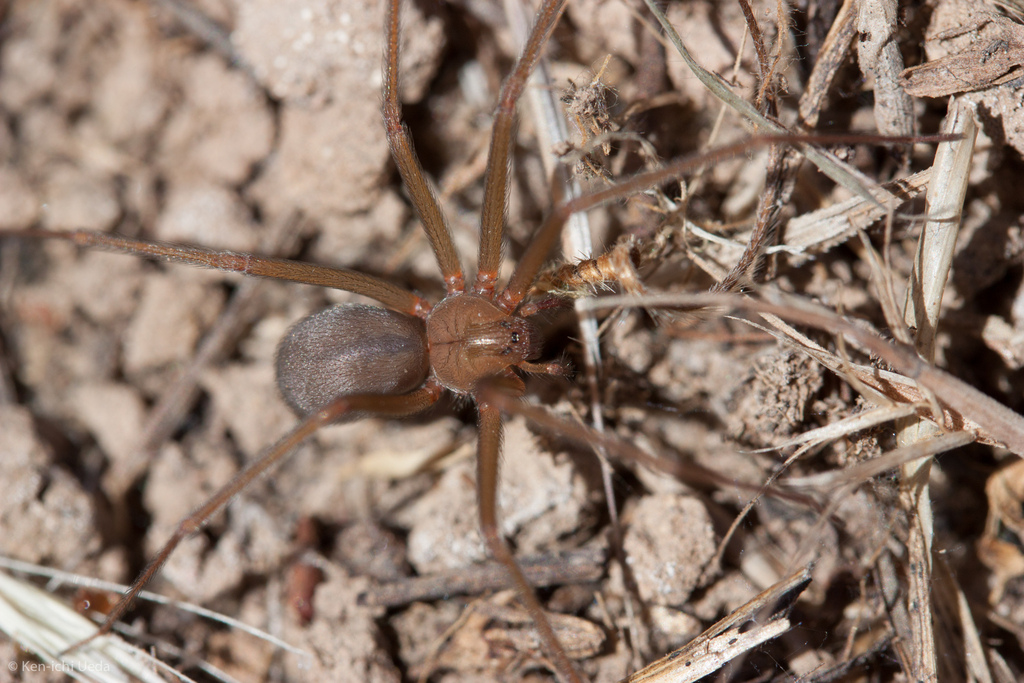
Desert recluse spiders have six equal eyes and a uniformly colored, hairy abdomen. They live in desert wild areas of the southwestern US and northwestern Mexico, especially near native vegetation and pack-rat dens, and are rarely found in homes. Their bite can produce necrotic skin lesions similar to those of the brown recluse.
How to recognize it
Desert recluse spiders have six eyes of equal size arranged in three pairs. Their abdomen is covered with fine hairs and is a uniform color from light beige to dark brown.
Source: UC IPM
Is it a pest in the house?
It is rarely a household pest, appearing only near native desert vegetation and not in urban settings.
Does it bite or sting?
A bite from the desert recluse can cause skin lesions due to its venom. The effects are produced by the same mechanism as the brown recluse bite. Many lesions are misdiagnosed as brown recluse bites, which can lead to serious consequences.
How to get rid of it
If a recluse spider is found in California, it is most likely the desert recluse. Identifying Loxosceles species requires a high-magnification microscope and an arachnologist’s expertise.
Source: UC IPM
Where it lives
They live in wild desert habitats and are only found near native vegetation, avoiding urban areas and lawns. Populations are especially dense in pack-rat dens.
Source: Wikipedia
Where it comes from
The desert recluse is native to the United States and Mexico.
Source: Wikipedia
Lookalikes
It is often mistaken for L. unicolor of South America or the brown recluse (L. reclusa), which do not occur in its range. Spitting spiders (Scytodes spp.) have a similar six-eye pattern and can be confused with recluse spiders. Common tan or gray spiders with dark head markings are also frequently misidentified as true recluse spiders.
Where it is found in the US
Recorded in 6 of 51 states and DC. Most records: California, Arizona, Nevada, New Mexico, Kansas, Utah.
Darker = more records. Counts are museum and citizen-science records, not population size.
Source: GBIF
Status: native in North America; native in United States. Source: iNaturalist
Months it is reported in the US
Source: GBIF
More photos


Questions people ask
Do desert recluse spiders bite?
Yes, their bite can cause necrotic skin lesions similar to those of the brown recluse.
Source: Wikipedia
How can I tell a desert recluse apart from a brown recluse?
Desert recluses live in desert wild areas of the southwestern US and Mexico, while brown recluses are not found in California; also, accurate species ID needs a microscope and expert analysis.
Where are desert recluse spiders found?
They are native to the United States and Mexico, especially in desert regions of southern California, Nevada, Arizona, New Mexico, and Utah.
Source: Wikipedia
Same family (Sicariidae)
Sources
- Wikipedia: https://en.wikipedia.org/wiki/Loxosceles_deserta
- UC IPM: https://ipm.ucanr.edu/PMG/PESTNOTES/pn7468.html
Look it up elsewhere: GBIF · iNaturalist · BugGuide · ITIS · Wikipedia
Text written 2026-10-23 from the sources above and checked sentence by sentence against them. Data fetched 2026-10-23.