 Bug FAQ
Crab Louse
Pthirus pubis · Order: Psocodea · Family: Pthiridae
Also called: Human Pubic Louse, Louse, Pubic Louse
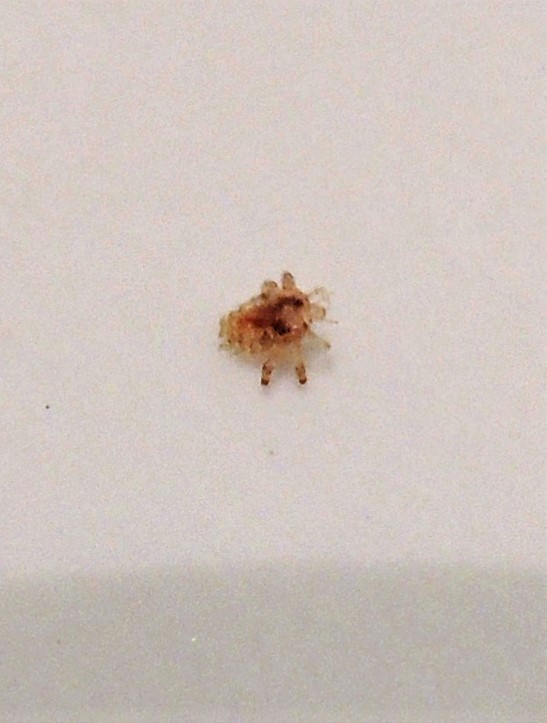
Crab lice are tiny gray-tan insects about 1.3 to 2 mm long that live mainly in pubic hair and other coarse body hair. They feed exclusively on human blood, taking several meals each day, which leads to itching and sometimes skin irritation. Infestations spread mainly through sexual contact but can also be passed by close personal contact or sharing contaminated clothing or bedding.
Source: Wikipedia, pubs.ext.vt.edu, UF/IFAS
How to recognize it
The front legs are delicate with long claws, while the second and third pairs are thick with large claws for gripping hair.
Source: Wikipedia, UF/IFAS, pubs.ext.vt.edu
Size
Adults measure roughly 1.3 to 2 mm in length.
Source: Wikipedia
Is it a pest in the house?
Infestations are spread mainly through sexual contact, but close personal contact or sharing contaminated clothing, bedding, or towels can also transmit them. Crab lice do not live on pets and cannot be acquired from dogs or other animals. Transmission from furniture or towels is possible only if the items are taken from an infested person very soon after contact.
Source: Wikipedia, pubs.ext.vt.edu
Does it bite or sting?
The main symptom is itching in the infested hair area, caused by an allergic reaction to louse saliva. Some people experience severe itching, while others have milder irritation.
How to get rid of it
Diagnosis is made by finding live lice or nits on the hair. Treat all affected people and their belongings on the same day with a medicated shampoo or lotion labeled for lice. Check close contacts and family members for infestation as well.
Source: Wikipedia, pubs.ext.vt.edu
Where it lives
They are usually found in pubic hair but can also live in the perianal area, armpits, beard, mustache, eyelashes, or on the scalp of very hairy people.
What it eats
Crab lice feed only on human blood.
Source: Wikipedia
Life cycle
Females lay eggs on coarse hairs in the genital and perianal regions; eggs hatch in 6 to 8 days and develop through three nymph stages over 10 to 17 days, reaching adulthood in 16 to 25 days total.
Source: Wikipedia
Where it comes from
The species diverged from the gorilla louse about 3.3 million years ago.
Source: Wikipedia
Lookalikes
Crab lice are distinct from head and body lice; they have a round body, stout rear legs with large claws, and a very short, broad abdomen. All three lice types crawl only; none can fly or jump.
Source: Wikipedia, UF/IFAS, pubs.ext.vt.edu
Where it is found in the US
Recorded in 19 of 51 states and DC. Most records: Connecticut, Michigan, Iowa, Illinois, Wisconsin, Florida, Massachusetts, Montana.
Darker = more records. Counts are museum and citizen-science records, not population size.
Source: GBIF
Status: native in North America; native in Canada. Source: iNaturalist
Months it is reported in the US
Source: GBIF
Questions people ask
Can crab lice be caught from pets?
No, they only live on humans and cannot be acquired from dogs or other animals.
Source: pubs.ext.vt.edu
How are crab lice transmitted?
They spread mainly through sexual contact, but close personal contact or sharing contaminated clothing, bedding, or towels can also pass them.
Source: Wikipedia
What do crab lice look like?
They are gray-tan, about 1.3 to 2 mm long, with a round body; the front legs are delicate, while the second and third pairs are thick with large claws.
Source: Wikipedia, pubs.ext.vt.edu, UF/IFAS
Sources
- Wikipedia: https://en.wikipedia.org/wiki/Crab_louse
- UF/IFAS: https://edis.ifas.ufl.edu/publication/IN260
- pubs.ext.vt.edu: https://pubs.ext.vt.edu/ENTO/ENTO-144.html
Look it up elsewhere: GBIF · iNaturalist · BugGuide · ITIS · Wikipedia
Text written 2026-10-23 from the sources above and checked sentence by sentence against them. Data fetched 2026-10-23.