 Bug FAQ
Corn Delphacid
Peregrinus maidis · Order: Hemiptera · Family: Delphacidae
Also called: Corn leafhopper, Maize planthopper, corn planthopper
Source: Wikipedia
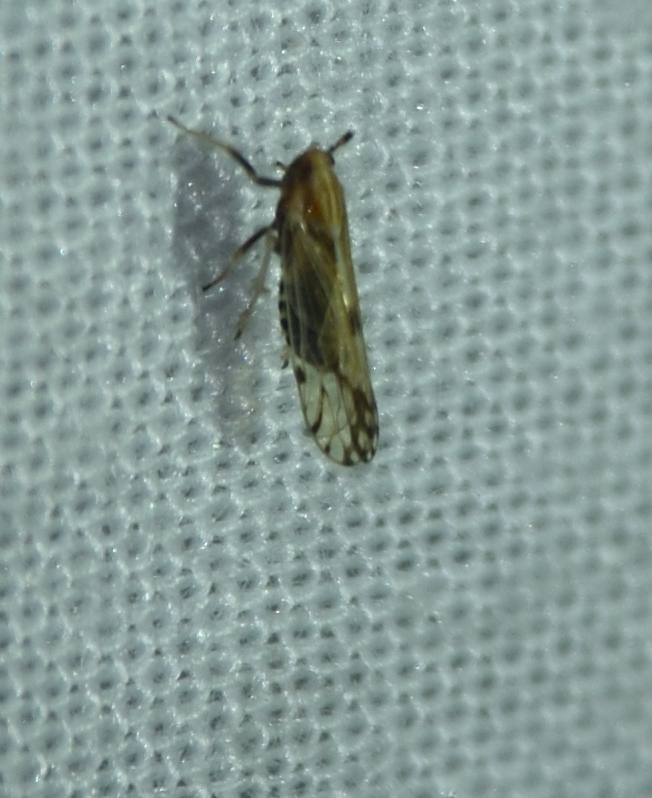
Corn Delphacid is a small yellow bug with dark markings; males are about 2 mm long with 6 mm wings and females about 3 mm long with 7 mm wings. It lives in warm, humid low-elevation areas worldwide, especially in tropical and subtropical regions, and it feeds by piercing plant veins and sucking sap. Females lay 20 to 30 eggs in leaf midribs and the insects develop to adults in roughly 20 days, making them a year-round pest of maize.
Source: Wikipedia
How to recognize it
Its forewings are longer than its body, and the hind tibiae have many spines and a large movable spur.
Source: Wikipedia
Size
Males measure about 2 mm in body length with a 6 mm wingspan. Females are slightly larger, about 3 mm long with a 7 mm wingspan.
Source: Wikipedia
Is it a pest in the house?
It is an economically important pest of maize. Infestations damage the plant by piercing vascular tissue and feeding on the sap.
Source: Wikipedia
How to get rid of it
- Farmers should limit nitrogen fertilizer use because it directly boosts the bug’s success.
- Corn varieties engineered with a modified resistance gene have shown some effectiveness against it.
Source: Wikipedia
Where it lives
The bug prefers low-elevation, high-humidity sites and becomes less common above 800 m.
Source: Wikipedia
Life cycle
Females deposit 20 to 30 eggs inside the midribs of host-plant leaves. Under normal conditions the insect develops from hatchling to adult in about 20 days, though temperature strongly influences development speed.
Source: Wikipedia
When you see it
It can reproduce year-round in warm climates, but its development rate changes with temperature fluctuations.
Source: Wikipedia
Where it comes from
It likely originated in Australia as a sorghum pest and spread quickly with the cultivation of sugarcane and maize.
Source: Wikipedia
Where it is found in the US
Recorded in 9 of 51 states and DC. Most records: Mississippi, Louisiana, Florida, Pennsylvania, Texas, Hawaii, California, Alabama.
Darker = more records. Counts are museum and citizen-science records, not population size.
Source: GBIF
Status: introduced in North America; introduced in United States. Source: iNaturalist
Months it is reported in the US
Source: GBIF
More photos
Questions people ask
What can be done to control Corn Delphacid?
Avoid using nitrogen fertilizers and consider planting corn that carries a modified resistance gene, both of which can reduce infestations.
Source: Wikipedia
Where is Corn Delphacid found?
It lives in tropical and subtropical low-elevation areas worldwide, including the southeastern United States and many other warm regions.
Source: Wikipedia
How fast does it develop?
Development from egg to adult takes about 20 days under normal conditions, but temperature greatly affects the rate.
Source: Wikipedia
Same family (Delphacidae)

Sources
- Wikipedia: https://en.wikipedia.org/wiki/Peregrinus_maidis
Look it up elsewhere: GBIF · iNaturalist · BugGuide · ITIS · Wikipedia
Text written 2026-10-28 from the sources above and checked sentence by sentence against them. Data fetched 2026-10-28.