 Bug FAQ
Common Water Measurer
Hydrometra stagnorum · Order: Hemiptera · Family: Hydrometridae
Also called: Water Measurer

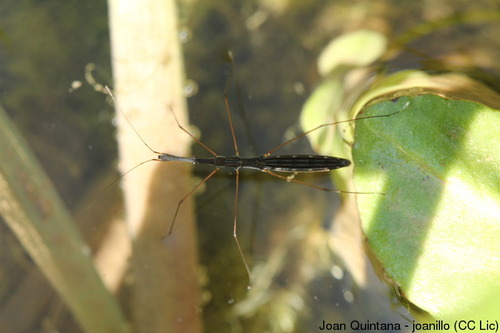
The common water measurer is a long, thin bug that is usually dark grey or black in colour. It lives among emergent plant stems at the edges of slow-moving streams, ditches and ponds, where it lays its eggs. It feeds by spearing mosquito larvae and water fleas just below the water surface.
Source: Wikipedia
How to recognize it
The insect is dark greyish to black and has a long, thin head and body.
Source: Wikipedia
Where it lives
It is found at vegetated margins of slow streams, ditches and ponds, close to emergent plant stems.
Source: Wikipedia
What it eats
It hunts mosquito larvae and water fleas just under the water film, catching them by spearing through the surface.
Source: Wikipedia
Life cycle
Adults are normally wingless, but some individuals develop full wings.
Source: Wikipedia
Where it comes from
It occurs in many European countries, including Hungary, Austria, and is common in Leicestershire and Rutland in Great Britain.
Source: Wikipedia
More photos
Questions people ask
What does the common water measurer look like?
It is dark grey to black and has a long, thin body and head.
Source: Wikipedia
Where does this bug live?
It lives at the vegetated edges of slow streams, ditches and ponds, near emergent plant stems where it lays eggs.
Source: Wikipedia
What does it eat?
It preys on mosquito larvae and water fleas just below the water surface, spearing them through the film.
Source: Wikipedia
Is it found in the UK?
Yes, it is common in Leicestershire and Rutland and occurs in many other European countries.
Source: Wikipedia
Sources
- Wikipedia: https://en.wikipedia.org/wiki/Hydrometra_stagnorum
Look it up elsewhere: GBIF · iNaturalist · BugGuide · ITIS · Wikipedia
Text written 2026-10-23 from the sources above and checked sentence by sentence against them. Data fetched 2026-10-22.