 Bug FAQ
Common Stony-cased Caddisfly
Pycnocentrodes aeris · Order: Trichoptera · Family: Conoesucidae
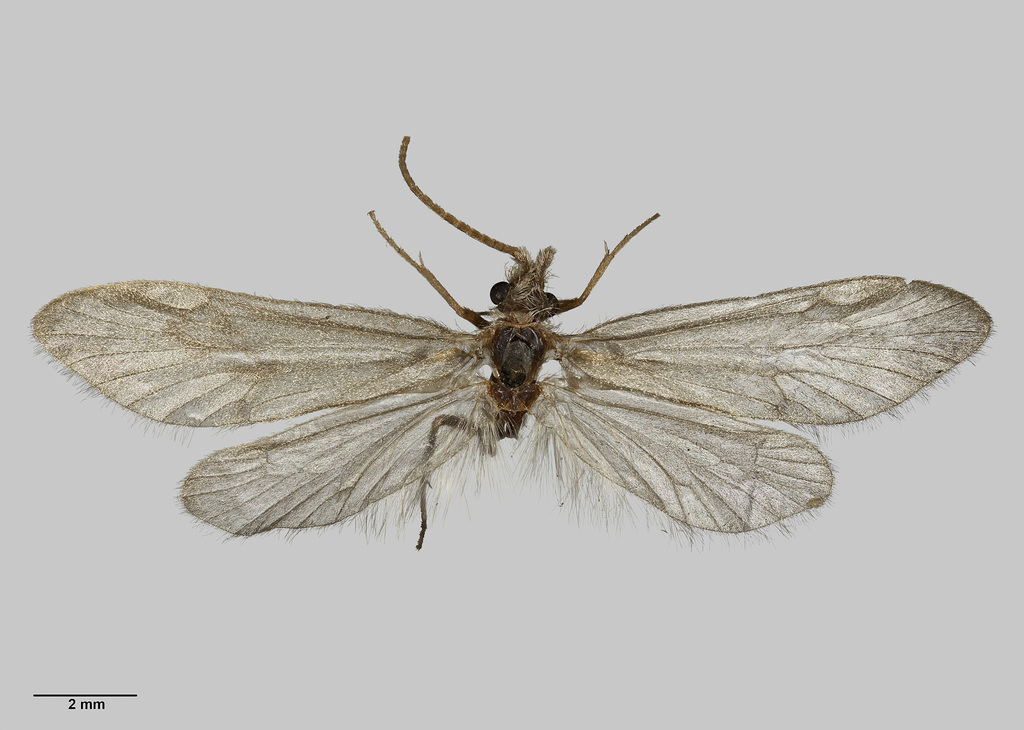
The common stony-cased caddisfly has forewings about 8 mm long and hind wings around 5.6 mm (0.31 in and 0.22 in). Its anterior wings are almost colourless with pale testaceous markings: two elongate dots near the base and two parallel lines that join and continue toward the dorsum. It is endemic to New Zealand and occurs throughout both the North and South Islands.
Source: Wikipedia
How to recognize it
The front wings are nearly clear with pale brown spots and lines that form a distinctive pattern near the wing base and along the costa.
Source: Wikipedia
Size
The anterior wing measures between 7 and 10 mm (0.28 to 0.39 in).
Source: Wikipedia
Where it lives
It is the most widespread Pycnocentrodes species in New Zealand, found across both main islands.
Source: Wikipedia
What it eats
Larvae build protective cases by gluing sand particles together with silk and will repair damaged cases.
Source: Wikipedia
Life cycle
During development the larvae construct and maintain sand-silk cases.
Source: Wikipedia
Where it comes from
The species is endemic to New Zealand.
Source: Wikipedia
Lookalikes
It can be told apart from P. aureola by the pattern on the posterior wing where veins R2 and R3 arise separately, a trait it shares with P. chiltoni.
Source: Wikipedia
Questions people ask
What do the larvae of the common stony-cased caddisfly make?
They construct cases from sand particles bound together with silk and will fix any damage to those cases.
Source: Wikipedia
How can I tell this caddisfly apart from similar species?
Look at the posterior wing; this species has veins R2 and R3 arising separately, unlike P. aureola.
Source: Wikipedia
Sources
- Wikipedia: https://en.wikipedia.org/wiki/Pycnocentrodes_aeris
Look it up elsewhere: GBIF · iNaturalist · BugGuide · ITIS · Wikipedia
Text written 2026-10-23 from the sources above and checked sentence by sentence against them. Data fetched 2026-10-23.