 Bug FAQ
Common Spitting Spider
Scytodes thoracica · Order: Araneae · Family: Scytodidae
Also called: Spitting Spider
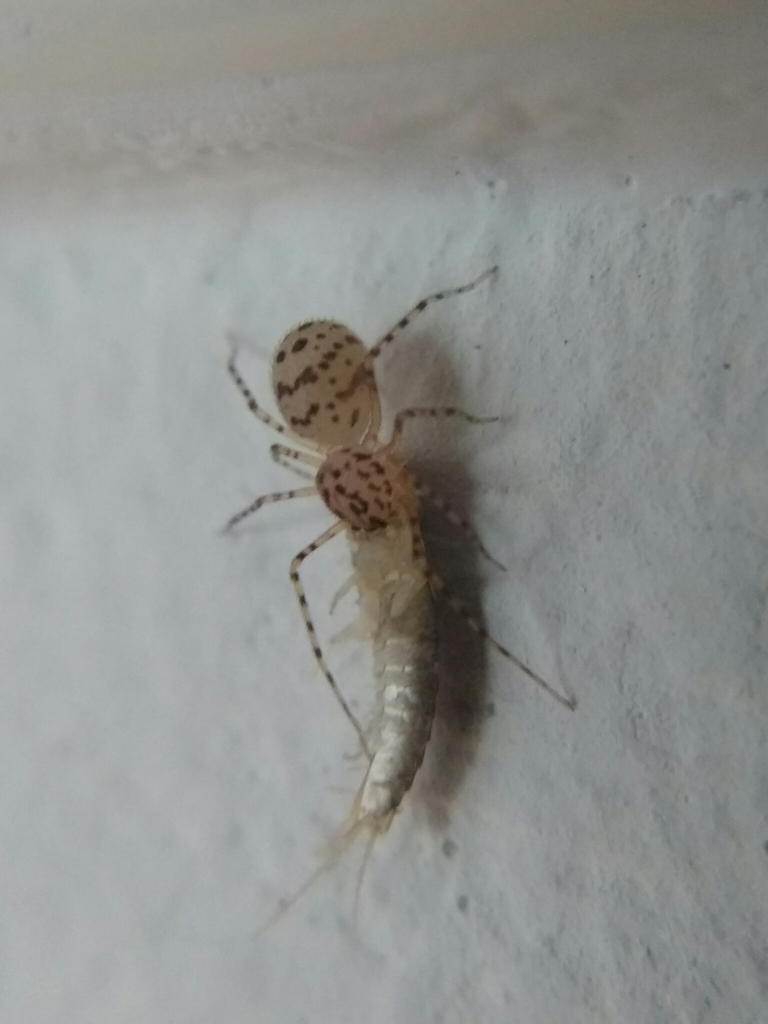
The common spitting spider is a tiny arachnid about 3 to 6 mm long that lives in homes and hunts at night. It catches prey by spraying a sticky, venom-filled silk from its cephalothorax and the mother cares for her young in a silk nursery.
Source: Wikipedia
Size
Adults measure between 3 and 6 mm in length.
Source: Wikipedia
Where it lives
It is a worldwide species that is often found inside houses, moving around at night.
Source: Wikipedia
What it eats
It is called a spitting spider because it ejects a venomous sticky silk to immobilize prey.
Source: Wikipedia
Life cycle
The female builds a silk nursery for spiderlings and carries her eggs under her abdomen in a silk net.
Source: Wikipedia
When you see it
Hunting takes place at night when some insects are less active.
Source: Wikipedia
Where it comes from
Its range includes Europe, North Africa, Turkey, temperate Asia, China, Korea and Japan.
Source: Wikipedia
Lookalikes
Other arachnids such as pseudoscorpions also have silk glands in the cephalothorax.
Source: Wikipedia
Where it is found in the US
Recorded in 40 of 51 states and DC. Most records: New York, Massachusetts, California, Ohio, Utah, New Jersey, Illinois, Pennsylvania.
Darker = more records. Counts are museum and citizen-science records, not population size.
Source: GBIF
Status: introduced in North America; introduced in Canada; introduced in United States. Source: iNaturalist
Months it is reported in the US
Source: GBIF
More photos
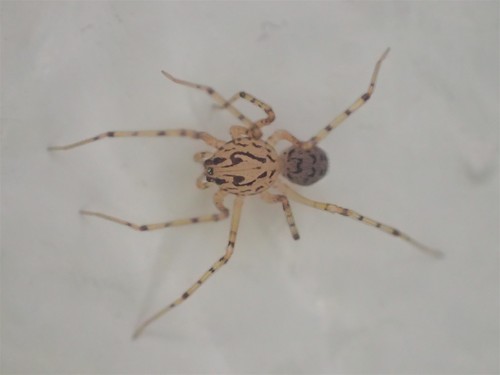

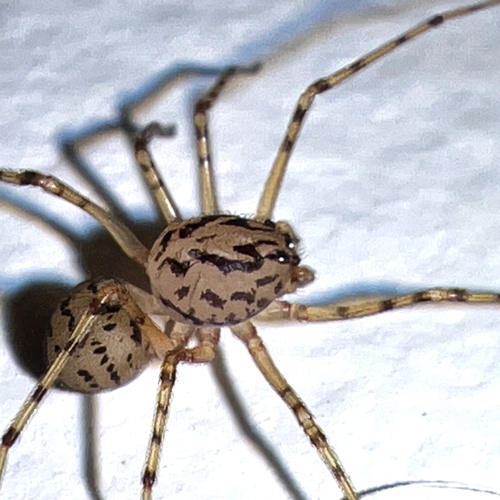
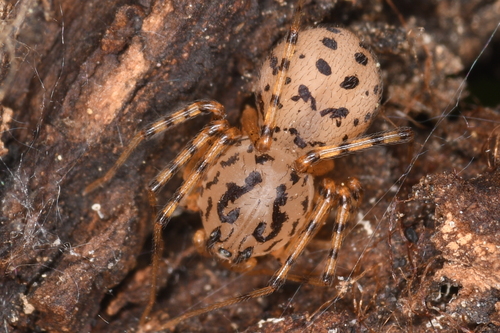
Same family (Scytodidae)

Sources
- Wikipedia: https://en.wikipedia.org/wiki/Scytodes_thoracica
Look it up elsewhere: GBIF · iNaturalist · BugGuide · ITIS · Wikipedia
Text written 2026-10-22 from the sources above and checked sentence by sentence against them. Data fetched 2026-10-22.