 Bug FAQ
Common Pill Millipede
Glomeris marginata · Order: Glomerida · Family: Glomeridae
Also called: Pill Millipede, bordered pill millipede
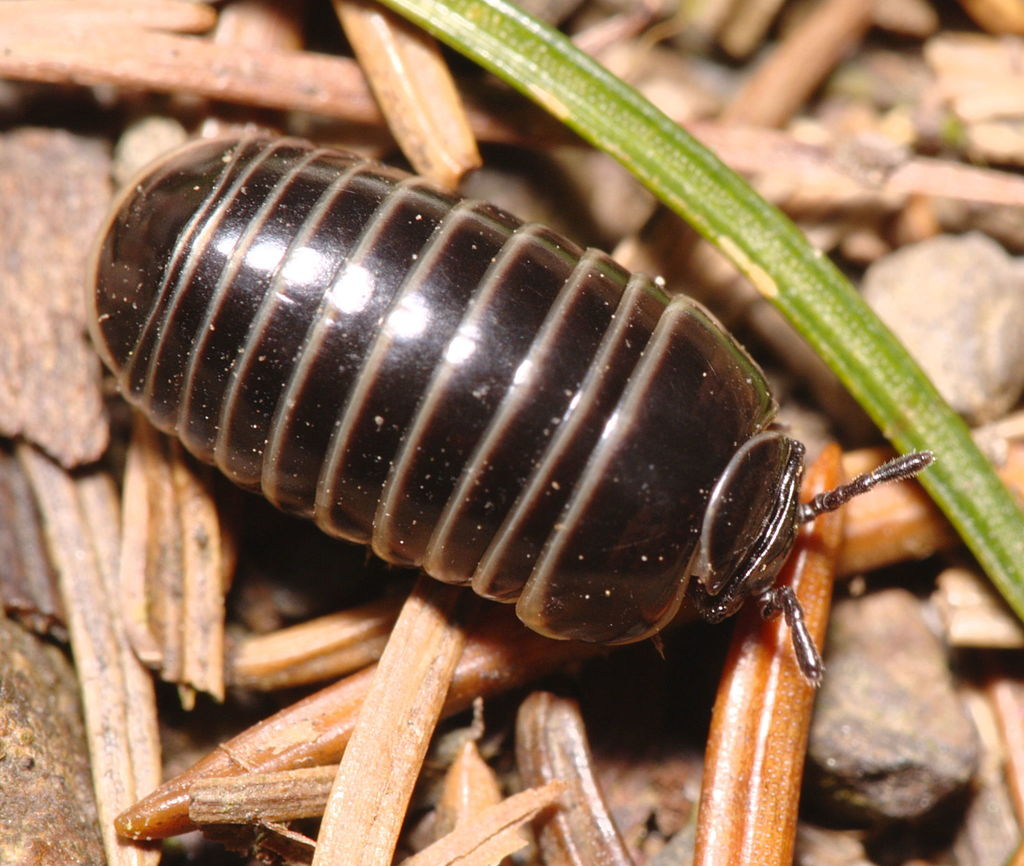
Females are 8-20 mm long and 4-8 mm wide; males are a bit smaller, 7-15 mm long and 3.5-6 mm wide. They live in leaf litter, grass, under stones and in garden hedgerows, especially where lime-rich soil is present.
Source: Wikipedia
How to recognize it
Their back plates are usually black with lighter edges, but can also appear brown, red or yellow, and the cuticle looks darker and shinier than that of pill woodlice.
Source: Wikipedia
Size
Females range from 8 mm to 20 mm long and 4 mm to 8 mm wide; males are 7 mm to 15 mm long and 3.5 mm to 6 mm wide.
Source: Wikipedia
Does it bite or sting?
When attacked it releases one to eight drops of a sticky fluid containing quinazolinone alkaloids (glomerin and homoglomerin).
Source: Wikipedia
Where it lives
They prefer leaf litter, grass, and the undersides of stones, especially on calcareous soils. In gardens they are found along hedgerows and at the base of old walls where mortar is crumbling and leaching lime.
Source: Wikipedia
What it eats
It feeds on old decaying leaves, helping recycle nutrients in leaf litter.
Source: Wikipedia
Life cycle
Juveniles take several years to become mature adults and can live up to ten or eleven years, molting once each year.
Source: Wikipedia
When you see it
Adults are present year-round but are collected most often in spring and autumn. Males become sexually mature in their seventh molt and usually breed by their second or third spring; females mature in their eighth molt and breed by their third or fourth spring.
Source: Wikipedia
Lookalikes
It is often mistaken for the pill woodlouse Armadillidium, which also rolls into a ball. Pill millipedes differ from pill woodlice in several physical traits.
Source: Wikipedia
Questions people ask
Are they a garden pest?
They feed on decaying leaf litter and help recycle nutrients, not on live plants.
Source: Wikipedia
How can I tell them apart from pill woodlice?
Their back plates are darker and shinier, and the overall coloration and body texture differ from woodlice.
Source: Wikipedia
Sources
- Wikipedia: https://en.wikipedia.org/wiki/Glomeris_marginata
Look it up elsewhere: GBIF · iNaturalist · BugGuide · Wikipedia
Text written 2026-10-22 from the sources above and checked sentence by sentence against them. Data fetched 2026-10-22.