 Bug FAQ
Common Nettle-tap
Anthophila fabriciana · Order: Lepidoptera · Family: Choreutidae
Also called: Nettle tap
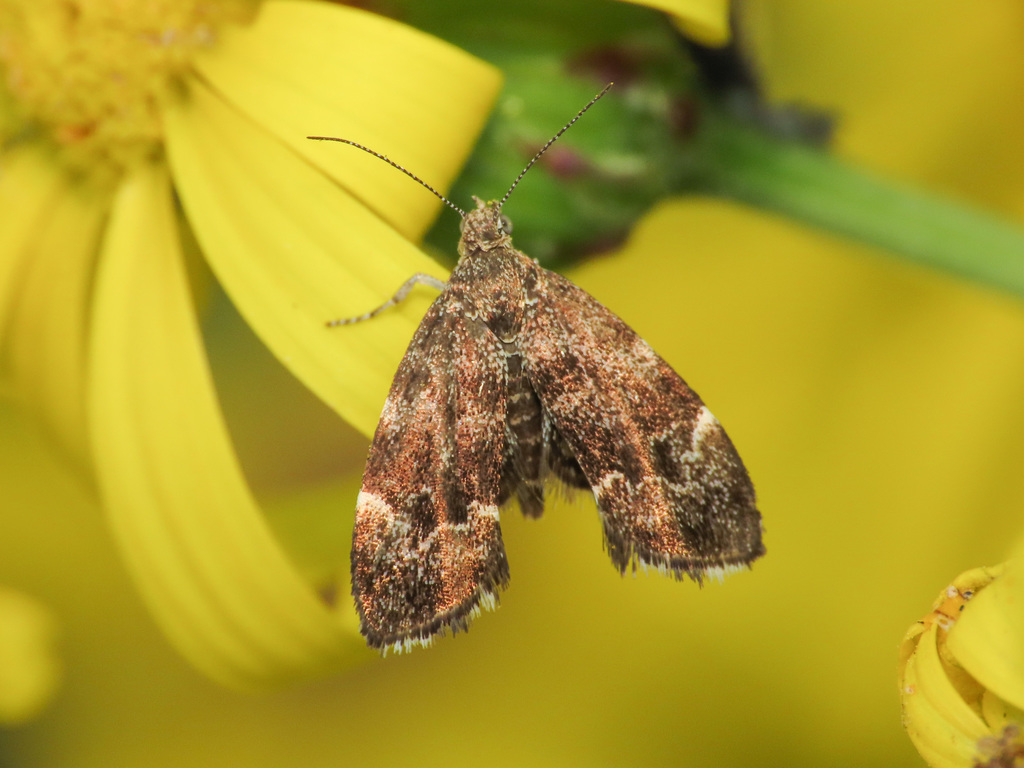
The common nettle-tap moth has a wingspan of about 10 to 15 mm and shows dark brownish forewings with pale grey marbling and a yellow-white spot near the leading edge, plus pale bands on the abdomen. It lives wherever stinging nettles grow, flies during the day in two generations from May to October, and its larvae feed mainly on stinging nettle but also on a few other plants. The species is widespread across most of Europe, Britain, and large parts of Asia including China, Japan, and the Canary Islands.
Source: Wikipedia
How to recognize it
Forewings are dark brownish-fuscous with pale grey marbling, a yellow-white spot on the costa, and a post-median band; the abdomen has large pale bands.
Source: Wikipedia
Size
Wingspan ranges from 10 to 15 mm (0.39 to 0.59 in).
Source: Wikipedia
Where it lives
Found wherever stinging nettles occur and can be seen flying around them in daylight.
Source: Wikipedia
Life cycle
Adults fly in two generations from May to October, are active by day, and some may overwinter.
Source: Wikipedia
When you see it
Flight period spans May to October, with two generations per year depending on location.
Source: Wikipedia
Lookalikes
Looks similar to Choreutis pariana, which only has whitish markings along the costa.
Source: Wikipedia
Where it is found in the US
Recorded in 4 of 51 states and DC. Most records: California, Montana, Washington, Idaho.
Darker = more records. Counts are museum and citizen-science records, not population size.
Source: GBIF
Status: native in Canada. Source: iNaturalist
Months it is reported in the US
Source: GBIF
More photos

Questions people ask
Is this moth a garden pest?
It feeds on stinging nettles and a few other plants but is not reported to damage crops or garden vegetables.
Source: Wikipedia
When can I see these moths?
They are active during the day from May through October, usually in two generations per year.
Source: Wikipedia
Where are they found?
They occur wherever stinging nettles grow, across most of Europe and large parts of Asia.
Source: Wikipedia
Sources
- Wikipedia: https://en.wikipedia.org/wiki/Anthophila_fabriciana
Look it up elsewhere: GBIF · iNaturalist · BugGuide · Wikipedia
Text written 2026-10-22 from the sources above and checked sentence by sentence against them. Data fetched 2026-10-22.