 Bug FAQ
Common Marine Caddisfly
Philanisus plebeius · Order: Trichoptera · Family: Chathamiidae
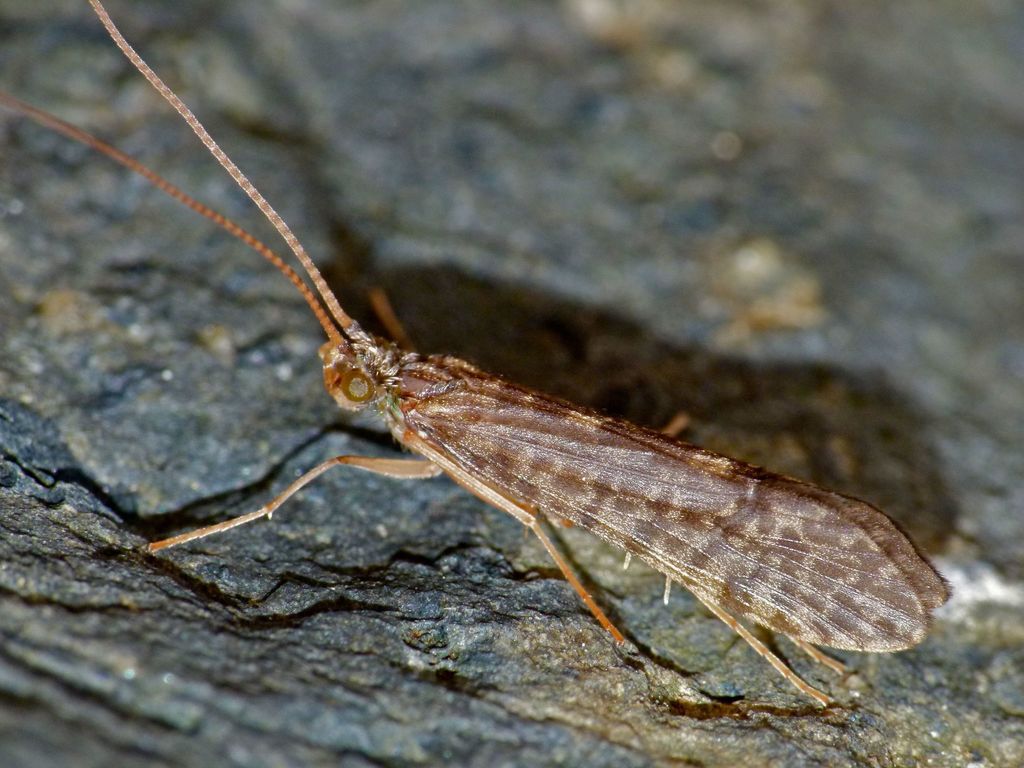
The common marine caddisfly is a small insect whose body is about 2½-2¾ lines long and whose wings span 7-8½ lines. Adults are winged and live on land, while females lay eggs inside starfish and the larvae develop in tide pools, building cases from seaweed, sand or shell fragments.
Source: Wikipedia
How to recognize it
Males are tawny, thinly clothed with tawny hairs; antennae are stout and much longer than the body; legs are long and testaceous; fore-tibiae lack spurs while hind-tibiae have two pairs of long spurs; the abdomen ends with two appendages; fore-wings are narrow, gray with pale brown marks; hind-wings are almost clear.
Source: Wikipedia
Size
Body length ranges from 2½ to 2¾ lines; wing length ranges from 7 to 8½ lines.
Source: Wikipedia
Where it lives
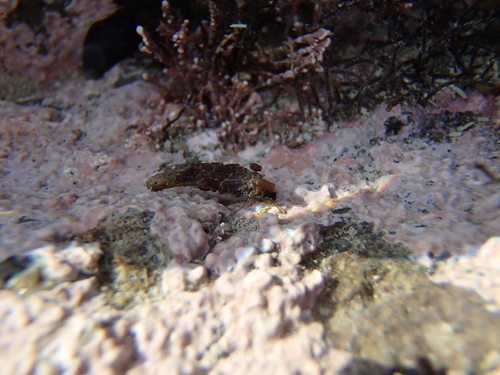
Adults are winged and live on land; eggs are laid inside starfish; larvae live in marine rock pools and tide pools. Larvae construct portable cases from seaweed such as Corallina or Zostera, together with bits of sand or shell.
Source: Wikipedia
What it eats
Larvae pass through seven instars, feeding on algae and detritus found in tide pools.
Source: Wikipedia
Life cycle
Females lay their eggs inside starfish. The larvae develop through seven instars, continuing to feed on algae and detritus in tide pools.
Source: Wikipedia
When you see it
Eggs can be found throughout the year inside the body cavity of cushion stars (Patiriella regularis in New Zealand and P. exigua in Australia).
Source: Wikipedia
Where it comes from
The species occurs along the coasts of New Zealand and the Australian state of New South Wales.
Source: Wikipedia
More photos
Questions people ask
Where can I find the common marine caddisfly?
Adults are terrestrial and winged, while the larvae live in tide pools and make cases from seaweed, sand or shell.
Source: Wikipedia
What do the larvae eat?
The larvae feed on algae and detritus in the tide pools they inhabit.
Source: Wikipedia
How does this caddisfly reproduce?
Females lay their eggs inside starfish, and the larvae develop through seven instars before becoming adults.
Source: Wikipedia
Sources
- Wikipedia: https://en.wikipedia.org/wiki/Philanisus_plebeius
Look it up elsewhere: GBIF · iNaturalist · BugGuide · ITIS · Wikipedia
Text written 2026-10-23 from the sources above and checked sentence by sentence against them. Data fetched 2026-10-23.