 Bug FAQ
Common fruit fly, Vinegar fly
Drosophila melanogaster · Order: Diptera · Family: Drosophilidae
Also called: Pomace fly
Source: Wikipedia

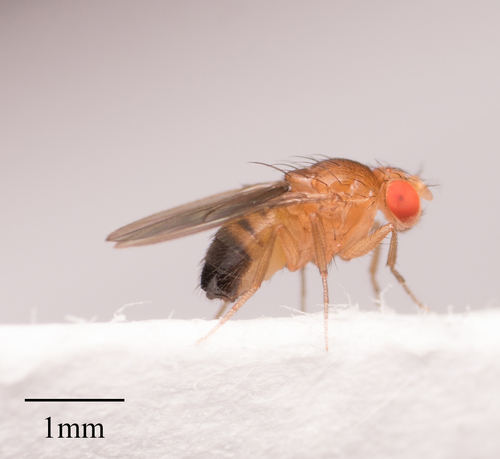
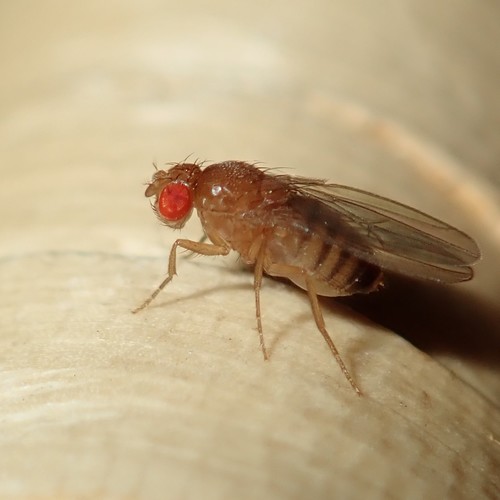
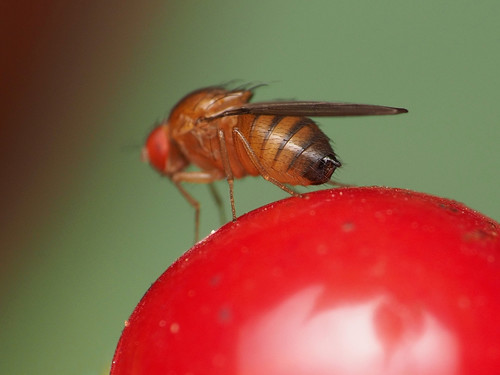
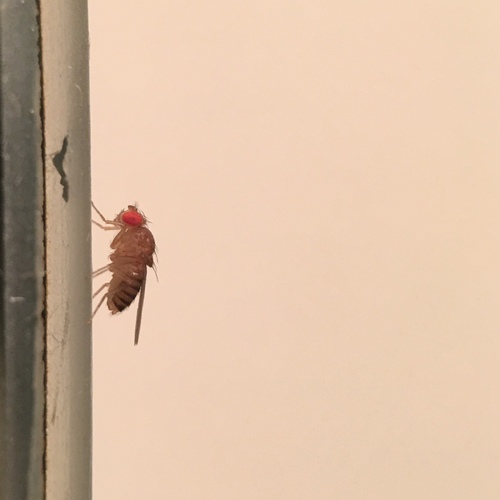
Adult fruit flies are about 2.5 mm long, with clear wings about 4 mm across and a yellow-brown body with brick-red eyes. They are attracted to rotting fruit, fermenting drinks and other decaying organic matter, so they often appear in kitchens, orchards and pubs.
Source: Wikipedia
How to recognize it
Wild-type flies have a yellow-brown color, brick-red eyes and black rings across the abdomen; males are darker and rounder, females are more pointed and striped.
Source: Wikipedia
Size
Females are about 2.5 mm long; males are slightly smaller. Wings are clear, membranous, with fine veins and span roughly 4 mm.
Source: Wikipedia
Where it lives
They are drawn to rotting fruit and fermenting beverages and are frequently found in orchards, kitchens and pubs.
Source: Wikipedia
What it eats
Larvae feed on microorganisms that decompose fruit and on the fruit’s sugars, while females lay about 400 eggs in rotting fruit or similar material.
Source: Wikipedia
Life cycle
At 25 °C the life cycle from egg to death takes about 50 days and includes embryo, larva, pupa and adult stages.
Source: Wikipedia
When you see it
Development from egg to adult can be as fast as seven days at 28 °C, but slows at higher temperatures such as 30 °C.
Source: Wikipedia
Where it comes from
Originally an African species, they now occur on all continents, including islands.
Source: Wikipedia
Lookalikes
They can be told apart from other fruit flies by features such as a small gena, hyaline wings with a costal index of 2.4, a male sex comb of about 12 setae, and specific abdominal markings in females.
Source: Wikipedia
Where it is found in the US
Recorded in 31 of 51 states and DC. Most records: California, North Carolina, Indiana, Ohio, Alaska, Michigan, New York, Texas.
Darker = more records. Counts are museum and citizen-science records, not population size.
Source: GBIF
Months it is reported in the US
Source: GBIF
More photos
Questions people ask
How can I recognize a common fruit fly?
Look for a tiny (≈2.5 mm) yellow-brown fly with brick-red eyes, clear wings about 4 mm wide, and black rings on the abdomen; males are darker and rounder, females are more pointed and striped.
Source: Wikipedia
Where are fruit flies likely to appear in my home?
They are attracted to rotting fruit, fermenting drinks and other decaying organic matter, so they often show up in kitchens, pantries, orchards, pubs and other places where food is stored or prepared.
Source: Wikipedia
Same family (Drosophilidae)


Sources
- Wikipedia: https://en.wikipedia.org/wiki/Drosophila_melanogaster
Look it up elsewhere: GBIF · iNaturalist · BugGuide · ITIS · Wikipedia
Text written 2026-10-23 from the sources above and checked sentence by sentence against them. Data fetched 2026-10-22.