 Bug FAQ
Clubbed Mydas Fly
Mydas clavatus · Order: Diptera · Family: Mydidae
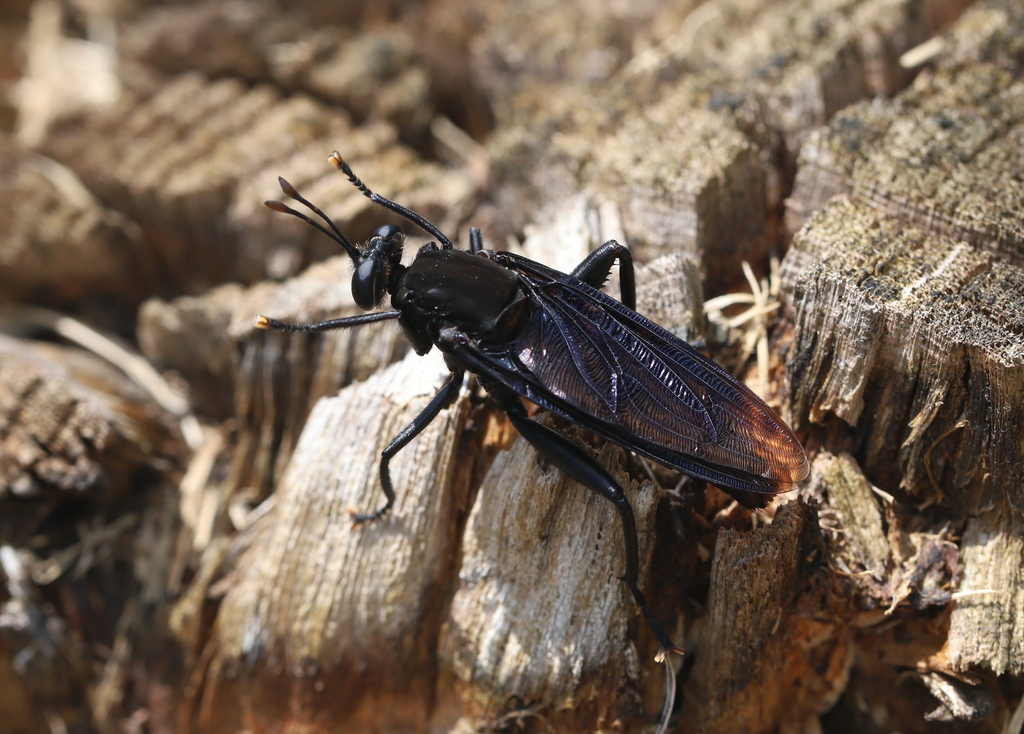
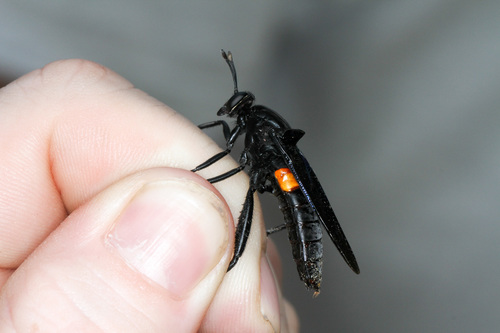
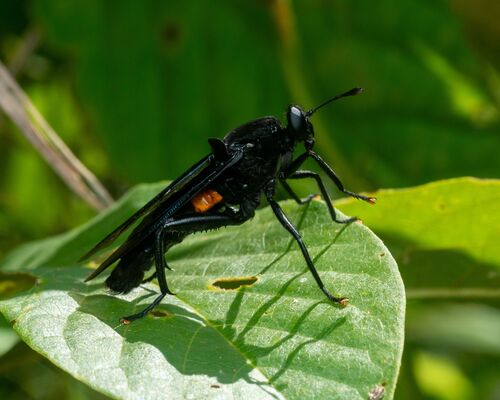
Clubbed mydas flies are large, black insects about 2.5 to 3 cm long with a wingspan over 5 cm and a bright orange-red spot on the underside of the second abdominal segment. They live in many open habitats such as woodlands, fields, gardens and meadows across eastern North America, and adults feed on pollen and nectar from a variety of flowers.
Source: Wikipedia
How to recognize it
The species gets its name from its club-shaped antennae, a trait common to all Mydas flies.
Source: Wikipedia
Size
Adults are 25 to 30 mm long and can have a wingspan exceeding 50 mm.
Source: Wikipedia
Where it lives
They are found in deciduous woodlands, fields, meadows, gardens and similar environments.
Source: Wikipedia
What it eats
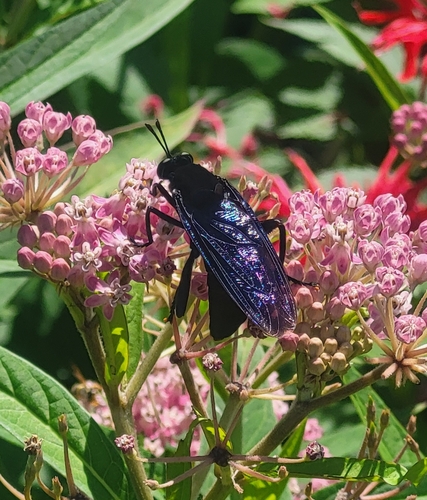
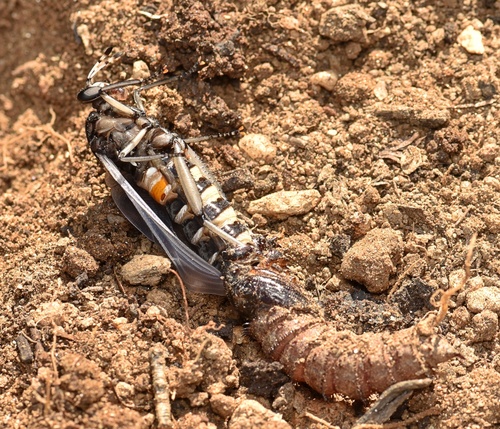
Adults visit flowers such as milkweed, spirea, monarda, and verbena for pollen and nectar. Larvae are predators of scarab beetle larvae that live in dead wood.
Source: Wikipedia
Life cycle
Females lay single eggs in soil or rotting wood. Larvae develop in standing or fallen trees with extensive heart rot, feeding on scarab beetle larvae.
Source: Wikipedia
When you see it
Adults are active in mid-summer.
Source: Wikipedia
Where it comes from
The species is native to temperate eastern North America.
Source: Wikipedia
Lookalikes
They mimic spider wasps and move boldly as a result.
Source: Wikipedia
Where it is found in the US
Recorded in 35 of 51 states and DC. Most records: Texas, Ohio, Virginia, Florida, North Carolina, Illinois, Maryland, Michigan.
Darker = more records. Counts are museum and citizen-science records, not population size.
Source: GBIF
Status: native in North America; native in Canada; native in United States. Source: iNaturalist
Months it is reported in the US
Source: GBIF
More photos
Sources
- Wikipedia: https://en.wikipedia.org/wiki/Mydas_clavatus
Look it up elsewhere: GBIF · iNaturalist · BugGuide · ITIS · Wikipedia
Text written 2026-10-22 from the sources above and checked sentence by sentence against them. Data fetched 2026-10-22.