 Bug FAQ
Citrine Forktail
Ischnura hastata · Order: Odonata · Family: Coenagrionidae

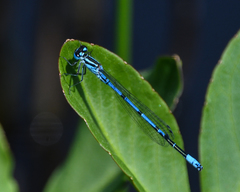
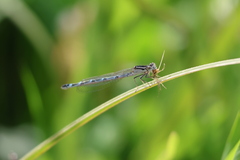
The citrine forktail is a small damselfly, only 20 to 27 mm long, with hindwings 11 to 15 mm. Males are black with blue markings and a mostly yellow abdomen, while females start orange with black on the head and rear abdomen. It lives in North and South America and also has a population in the Azores, flying year-round in the southern U.S. and from spring to fall farther north.
Source: Wikipedia
How to recognize it
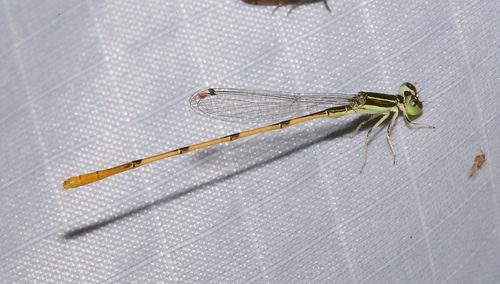
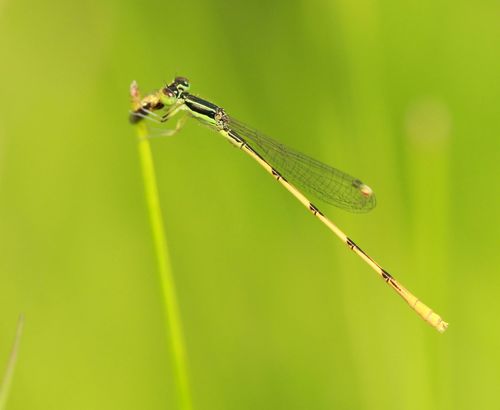
Females begin life mostly orange, with black on the head and the rear part of the abdomen.
Source: Wikipedia
Size
Adults measure 20 to 27 mm in length and have hindwings 11 to 15 mm long, making them smaller than most European Ischnura species.
Source: Wikipedia
Life cycle
In North America it follows the typical dragonfly life cycle.
Source: Wikipedia
When you see it
Adults are active year-round in the southern United States, from April to November farther north, and from May to August in the Azores.
Source: Wikipedia
Where it comes from
Its natural range includes North America, South America, and an introduced population on the Azores.
Source: Wikipedia
Lookalikes
Male citrine forktails are the only damselflies whose pterostigma is set away from the wing’s leading edge.
Source: Wikipedia
Where it is found in the US
Recorded in 41 of 51 states and DC. Most records: Texas, Florida, New Jersey, Ohio, Maryland, North Carolina, Georgia, Virginia.
Darker = more records. Counts are museum and citizen-science records, not population size.
Source: GBIF
Status: native in North America; native in Canada; native in United States. Source: iNaturalist
Months it is reported in the US
Source: GBIF
More photos


Same family (Coenagrionidae)


Sources
- Wikipedia: https://en.wikipedia.org/wiki/Citrine_forktail
Look it up elsewhere: GBIF · iNaturalist · BugGuide · ITIS · Wikipedia
Text written 2026-10-22 from the sources above and checked sentence by sentence against them. Data fetched 2026-10-22.