 Bug FAQ
Chilenocaecilius ornatipennis
Chilenocaecilius ornatipennis · Order: Psocodea · Family: Paracaeciliidae
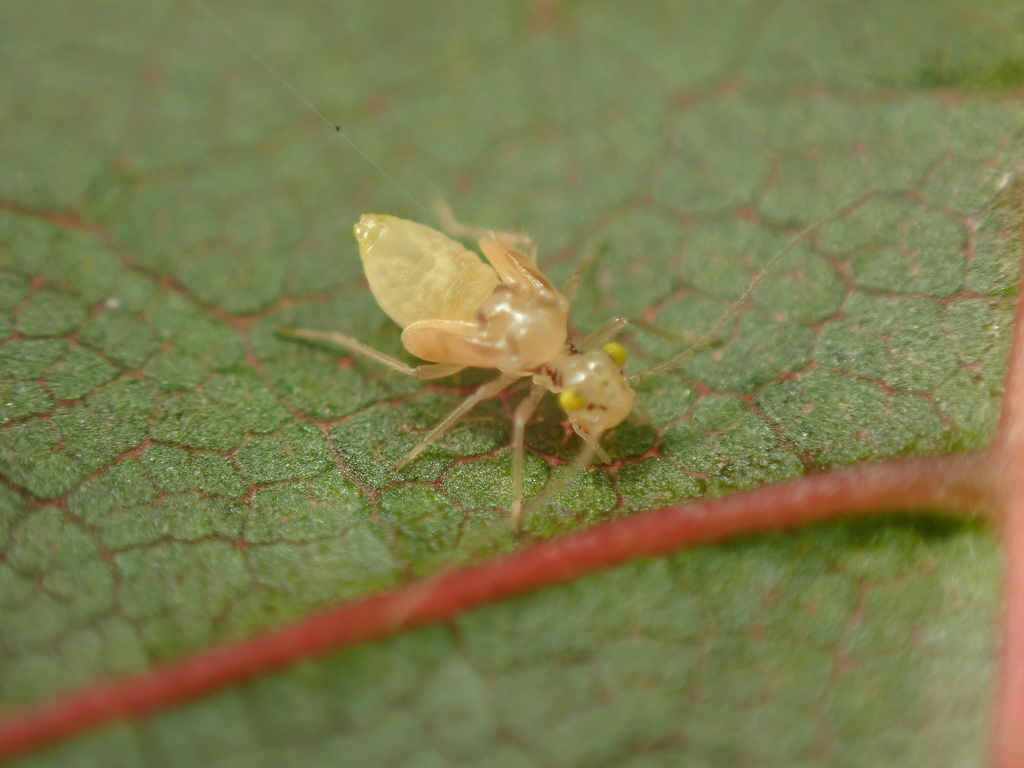
Chilenocaecilius ornatipennis is a medium-sized barkfly about 3.5 to 4 mm long and its body ranges from yellowish-white to medium brown, with a reddish-brown band on the head and a broad red-brown stripe on the thorax. It always has fully developed long wings that show dark smudges where the veins meet the wing edge, and the Cu2 vein lacks setae. The species lives on the foliage of many plants up to about 1,000 m altitude, is native to Chile and also found in two sites in Argentina, and most populations reproduce without males.
Source: Wikipedia
How to recognize it
Body colour varies from yellowish-white to medium brown. The thoracic pleura have a broad longitudinal red-brown band. Wings are fully developed, long, and always present. Wing pattern includes dark smudges at vein termini. The Cu2 vein lacks setae.
Source: Wikipedia
Size
Adults measure about 3.5 to 4 mm in length.
Source: Wikipedia
Where it lives
Found on the foliage of many kinds of vegetation.
Source: Wikipedia
Life cycle
Capable of sexual reproduction, but most populations are parthenogenetic and lack males.
Source: Wikipedia
Where it comes from
Native to South America, widespread in Chile with two known localities in Argentina.
Source: Wikipedia
Lookalikes
It is one of only two species in the genus Chilenocaecilius.
Source: Wikipedia
Where it is found in the US
Recorded in 3 of 51 states and DC. Most records: Washington, California, Oregon.
Darker = more records. Counts are museum and citizen-science records, not population size.
Source: GBIF
Status: introduced in United States. Source: iNaturalist
Months it is reported in the US
Source: GBIF
More photos


Sources
- Wikipedia: https://en.wikipedia.org/wiki/Chilenocaecilius_ornatipennis
Look it up elsewhere: GBIF · iNaturalist · BugGuide · Wikipedia
Text written 2026-10-23 from the sources above and checked sentence by sentence against them. Data fetched 2026-10-23.