 Bug FAQ
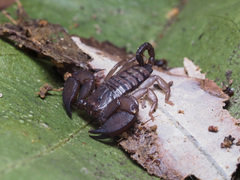
Cape Docile Scorpion
Opisthacanthus capensis · Order: Scorpiones · Family: Hormuridae
Source: Wikipedia

The Cape Docile Scorpion is a robust, dark brown to black scorpion that can turn green when hidden for a while. It lives in moist, dense vegetation such as pine plantations and forests, often hiding under bark or rocks. Its native range includes South Africa's Cape Province and Zimbabwe.
Source: Wikipedia
Does it bite or sting?
In humans it is only mildly venomous, with its sting causing only local pain.
Source: Wikipedia
Where it lives
Found mainly in moist habitats with dense vegetation, pine plantations, forests, and hiding under bark and rocks.
Source: Wikipedia
What it eats
It is prey for several mammals, including the bat-eared fox, yellow mongoose, small grey mongoose, and water mongoose.
Source: Wikipedia
Where it comes from
Native to the Cape Province of South Africa and Zimbabwe.
Source: Wikipedia
More photos


Questions people ask
Does the Cape Docile Scorpion sting?
Yes, its sting is mild and only causes local pain.
Source: Wikipedia
Where is this scorpion found?
It lives in moist, dense vegetation such as pine plantations and forests in the Cape Province of South Africa and Zimbabwe.
Source: Wikipedia
Same family (Hormuridae)


Sources
- Wikipedia: https://en.wikipedia.org/wiki/Opisthacanthus_capensis
Look it up elsewhere: GBIF · iNaturalist · BugGuide · Wikipedia
Text written 2026-10-23 from the sources above and checked sentence by sentence against them. Data fetched 2026-10-23.