 Bug FAQ
Brooklet Milkweed Bug
Spilostethus rivularis · Order: Hemiptera · Family: Lygaeidae

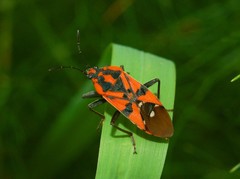
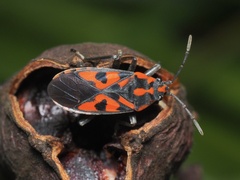
Adults are about 13 mm long. They are common in African grasslands, savannahs and croplands. Both nymphs and adults feed on milkweed seeds and related plants, and may be seen on composite flower heads.
Source: Wikipedia
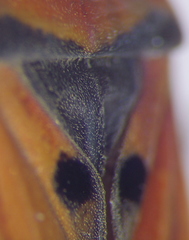
How to recognize it
Nymphs are bright yellow-orange to orange with brown stripes.
Source: Wikipedia
Size
Adults measure roughly 13 mm in length.
Source: Wikipedia
Where it lives
They are widely found across Africa in grassland, savannah grassland and cropland habitats.
Source: Wikipedia
What it eats
Members of the genus feed on seeds of various milkweed species, related Calotropis, and afrotropical Solanum plants. Adults are also found on the flower heads of many composite plants and often gather on Lopholaena coriifolia in South Africa.
Source: Wikipedia
Life cycle
The egg and immature stages were described by Slater and Perry in 1973.
Source: Wikipedia
Where it comes from
The species is widely distributed throughout Africa.
Source: Wikipedia
More photos


Questions people ask
What do the nymphs look like?
Nymphs are bright yellow-orange to orange with brown stripes.
Source: Wikipedia
Where does this bug live?
It is common across African grasslands, savannahs and croplands.
Source: Wikipedia
What does it eat?
It feeds on milkweed seeds, related Calotropis, afrotropical Solanum species, and can be seen on composite flower heads.
Source: Wikipedia
Same family (Lygaeidae)




Sources
- Wikipedia: https://en.wikipedia.org/wiki/Spilostethus_rivularis
Look it up elsewhere: GBIF · iNaturalist · BugGuide · Wikipedia
Text written 2026-10-23 from the sources above and checked sentence by sentence against them. Data fetched 2026-10-23.