 Bug FAQ
Bone Cave Harvestman
Texella reyesi · Order: Opiliones · Family: Phalangodidae
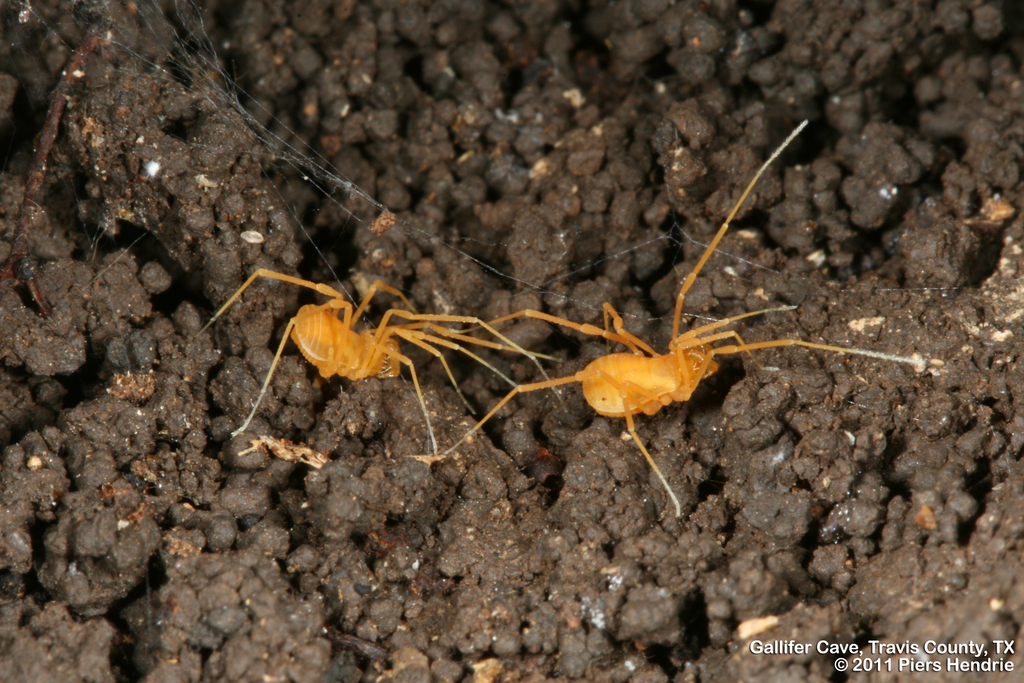
The Bone Cave harvestman is a tiny arachnid about 1.4 to 2.7 mm long with very long legs. It is pale orange and completely eyeless, adaptations for living its whole life in dark limestone caves. It lives only in limestone caves of Travis and Williamson Counties in Texas and feeds on other small invertebrates.
Source: Wikipedia
How to recognize it
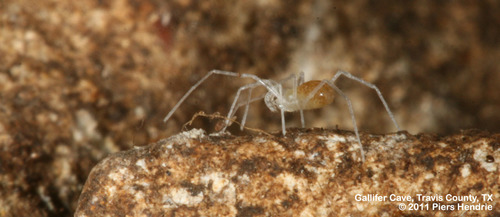
The harvestman has no eyes and a pale orange coloration. Its lack of eyes and pigment, plus long legs, are adaptations to a troglobitic (cave-only) lifestyle.
Source: Wikipedia
Size
Adults measure between 1.4 and 2.7 mm in length.
Source: Wikipedia
Where it lives
It inhabits limestone caves in Travis and Williamson Counties, Texas.
Source: Wikipedia
What it eats
It preys on other small invertebrates.
Source: Wikipedia
Life cycle
Texella reyesi was formally described as a new species in 1992.
Source: Wikipedia
Where it comes from
The species is endemic to Texas, United States.
Source: Wikipedia
Lookalikes
It was previously grouped with Texella reddelli, a close relative, before being recognized as a separate species.
Source: Wikipedia
Where it is found in the US
Recorded in 1 of 51 states and DC. Most records: Texas.
Darker = more records. Counts are museum and citizen-science records, not population size.
Source: GBIF
Status: endemic in North America. Source: iNaturalist
Months it is reported in the US
Source: GBIF
More photos
Questions people ask
Sources
- Wikipedia: https://en.wikipedia.org/wiki/Texella_reyesi
Look it up elsewhere: GBIF · iNaturalist · BugGuide · ITIS · Wikipedia
Text written 2026-10-27 from the sources above and checked sentence by sentence against them. Data fetched 2026-10-27.