 Bug FAQ
Blue-fronted Dancer
Argia apicalis · Order: Odonata · Family: Coenagrionidae

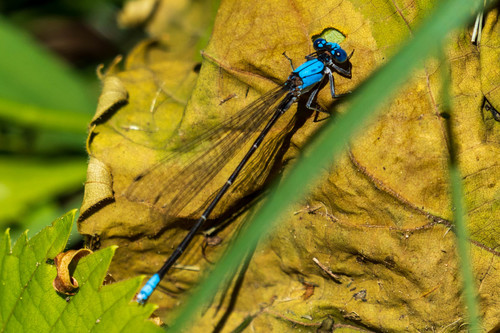
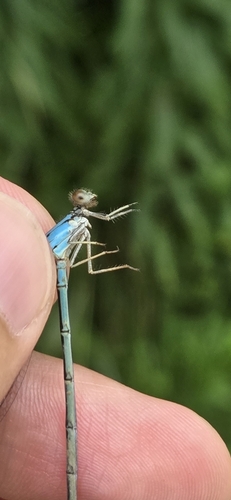
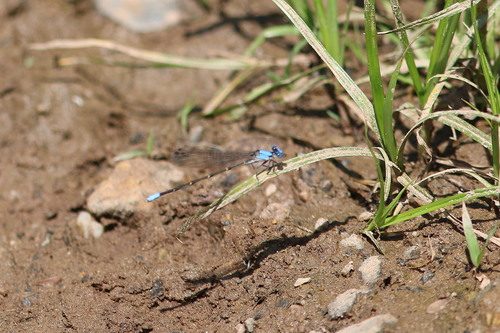
The blue-fronted dancer is a damselfly about 33 to 40 mm long (1.3 to 1.6 in) and adults appear from mid-summer onward. Males have a blue thorax with black lines and a bright-blue tip on the abdomen, while females can be brown, turquoise, or grayish-black. It lives near rivers, streams, lakes and ponds, especially large muddy rivers, and can be found in both wooded and treeless areas across parts of North America.
Source: Wikipedia
How to recognize it
Males show a blue thorax divided by thin black lines and have bright blue on the last three abdominal segments; the other segments are dark brown. Females may have a brown, turquoise, or gray-black thorax.
Source: Wikipedia
Size
Adults measure roughly 33 to 40 mm in length (about 1.3 to 1.6 in).
Source: Wikipedia
Where it lives
Occurs in both woodland and open, treeless sites.
Source: Wikipedia
Life cycle
Adults emerge over an extended period; marked males lived up to 33 days, most about 8 days, females about 7 days.
Source: Wikipedia
Where it comes from
Native to parts of North America.
Source: Wikipedia
Where it is found in the US
Recorded in 44 of 51 states and DC. Most records: Ohio, Texas, Illinois, Virginia, North Carolina, Maryland, Tennessee, Kansas.
Darker = more records. Counts are museum and citizen-science records, not population size.
Source: GBIF
Status: native in North America; native in United States; native in Canada. Source: iNaturalist
Months it is reported in the US
Source: GBIF
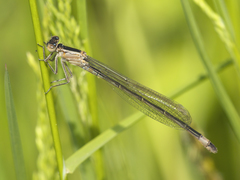
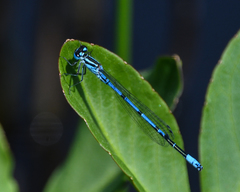
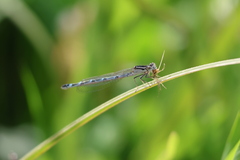
More photos

Same family (Coenagrionidae)


Sources
- Wikipedia: https://en.wikipedia.org/wiki/Blue-fronted_dancer
Look it up elsewhere: GBIF · iNaturalist · BugGuide · ITIS · Wikipedia
Text written 2026-10-22 from the sources above and checked sentence by sentence against them. Data fetched 2026-10-22.