 Bug FAQ
Blue Eyes Lacewing
Nymphes myrmeleonoides · Order: Neuroptera · Family: Nymphidae
Also called: Blue-eyed Lacewing
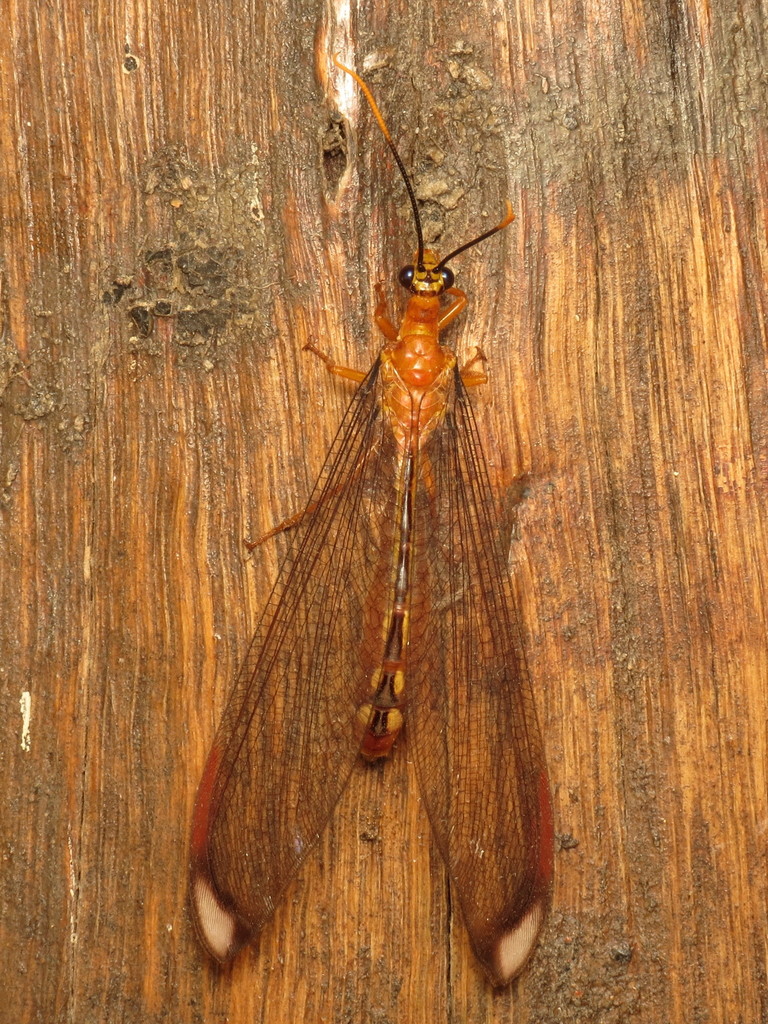
The blue eyes lacewing can grow up to 4 cm long with a wingspan of about 11 cm, and each wing ends in a white tip. It lives in New South Wales and Queensland in Australia. Its larvae dig pits in loose soil to trap prey, similar to antlion larvae.
Source: Wikipedia
How to recognize it
Each wing finishes with a distinctive white tip.
Source: Wikipedia
Size
Adults reach up to 4 cm in body length and have a wingspan of up to 11 cm.
Source: Wikipedia
What it eats
Larvae construct pit traps in loose soil to capture prey, resembling antlion behavior.
Source: Wikipedia
Life cycle
The larvae dig pits in loose soil to trap prey, similar to antlion larvae.
Source: Wikipedia
Where it comes from
It is an Australian insect.
Source: Wikipedia
Lookalikes
The larvae look like antlion larvae.
Source: Wikipedia
More photos
Questions people ask
What do the larvae of the blue eyes lacewing do?
They dig pits in loose soil to trap prey, much like antlion larvae.
Source: Wikipedia
Where is the blue eyes lacewing found?
It occurs in New South Wales and Queensland in Australia.
Source: Wikipedia
How large does the blue eyes lacewing get?
Adults can be up to 4 cm long with a wingspan of about 11 cm, and each wing ends in a white tip.
Source: Wikipedia
Sources
- Wikipedia: https://en.wikipedia.org/wiki/Nymphes_myrmeleonides
Look it up elsewhere: GBIF · iNaturalist · BugGuide · Wikipedia
Text written 2026-10-23 from the sources above and checked sentence by sentence against them. Data fetched 2026-10-22.