 Bug FAQ
Blue-eyed Ensign Wasp
Evania appendigaster · Order: Hymenoptera · Family: Evaniidae
Also called: Cockroach Egg Parasitoid Wasp, Common Cockroach Egg Parasitoid Wasp, Ensign Wasp
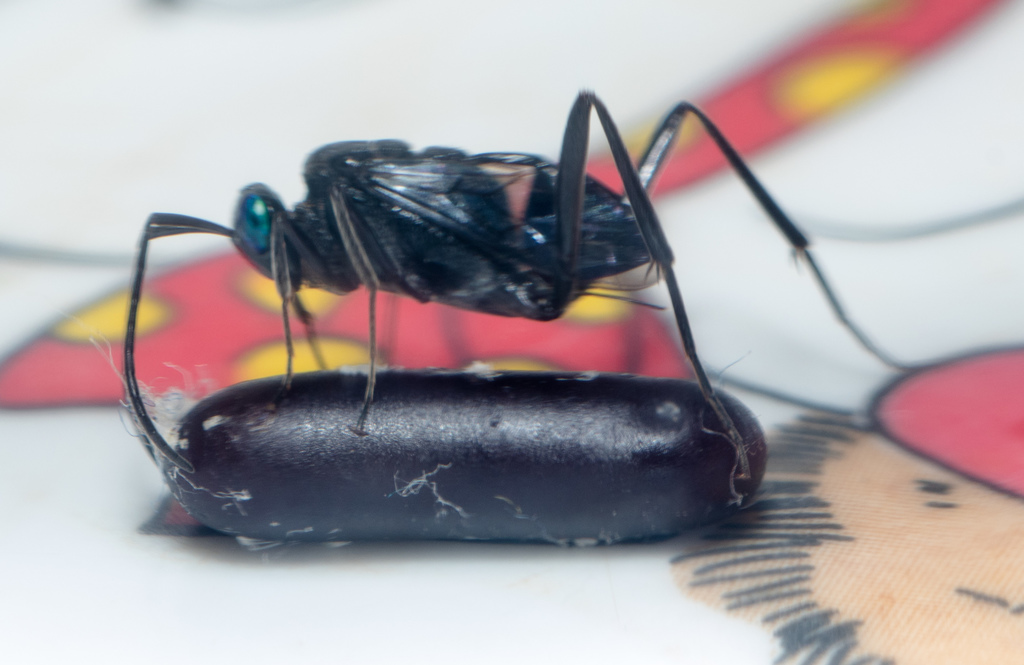
The blue-eyed ensign wasp is a small black wasp with striking blue eyes and a flag-shaped abdomen. It lives in tropical, subtropical and many temperate areas, often found on herbs like parsley and fennel. Females lay eggs inside cockroach oothecae; the larvae eat the cockroach eggs, pass through five instars, pupate at about 8 mm, and the adult lives only a few weeks (-).
Source: Wikipedia
How to recognize it
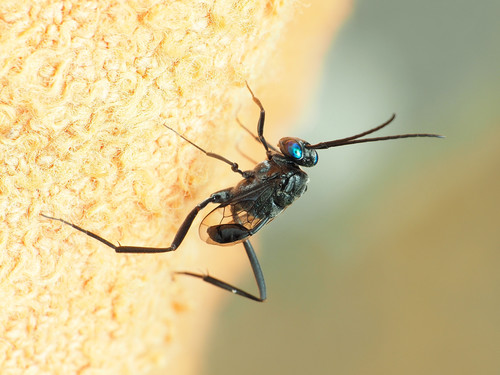
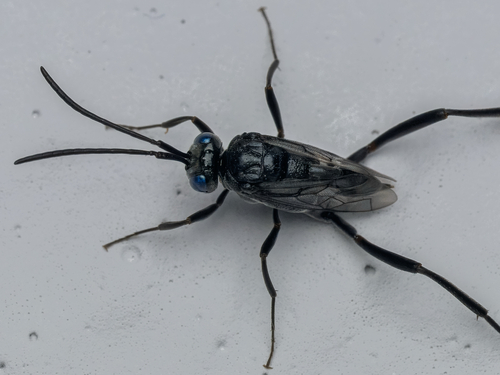
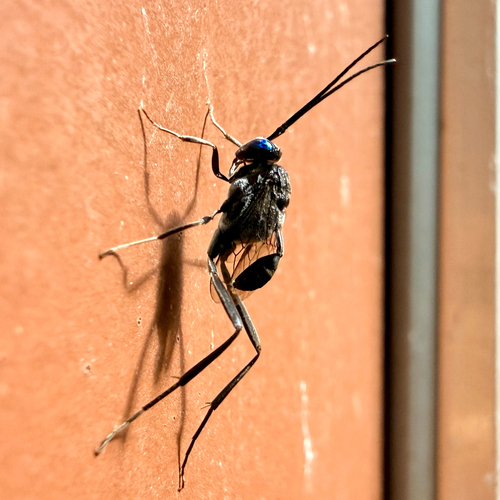
The body is black with bright blue eyes, and the narrow petiole attaches high on the abdomen, which is laterally flattened and flag-shaped.
Source: Wikipedia
Size
Forewings can be up to about 7 mm long, making it one of the larger ensign wasps.
Source: Wikipedia
How to get rid of it
Because it attacks cockroach eggs, it is being considered for biological control of cockroaches and can be reared in labs for release.
Source: Wikipedia
Where it lives
It occurs throughout the tropics, subtropics and many temperate regions, and may be seen on plants such as parsley and fennel.
Source: Wikipedia
What it eats
Adults are parasitoids that specialize in cockroach eggs, using the eggs as food for their larvae.
Source: Wikipedia
Life cycle
The larva consumes all the eggs inside the cockroach ootheca, goes through five instars distinguished by mandible changes, pupates at about 8 mm, then chews a hole to emerge as an adult that lives two to three weeks (-).
Source: Wikipedia
Where it comes from
Its exact native range is unknown, but it likely originated in tropical or oriental parts of Asia.
Source: Wikipedia
Lookalikes
A similar parasitoid wasp that also attacks cockroach oothecae is Aprostocetus hagenowii.
Source: Wikipedia
Where it is found in the US
Recorded in 23 of 51 states and DC. Most records: Texas, Florida, California, Louisiana, Hawaii, New York, Arizona, Alabama.
Darker = more records. Counts are museum and citizen-science records, not population size.
Source: GBIF
Status: introduced in United States. Source: iNaturalist
Months it is reported in the US
Source: GBIF
More photos

Questions people ask
Can they be used to control cockroaches?
Yes, they parasitize cockroach eggs and can be bred for release as a biological control agent.
Source: Wikipedia
Sources
- Wikipedia: https://en.wikipedia.org/wiki/Evania_appendigaster
Look it up elsewhere: GBIF · iNaturalist · BugGuide · ITIS · Wikipedia
Text written 2026-10-22 from the sources above and checked sentence by sentence against them. Data fetched 2026-10-22.