 Bug FAQ
Blackberry Skeletonizer
Schreckensteinia festaliella · Order: Lepidoptera · Family: Schreckensteiniidae
Also called: Bramble False-feather
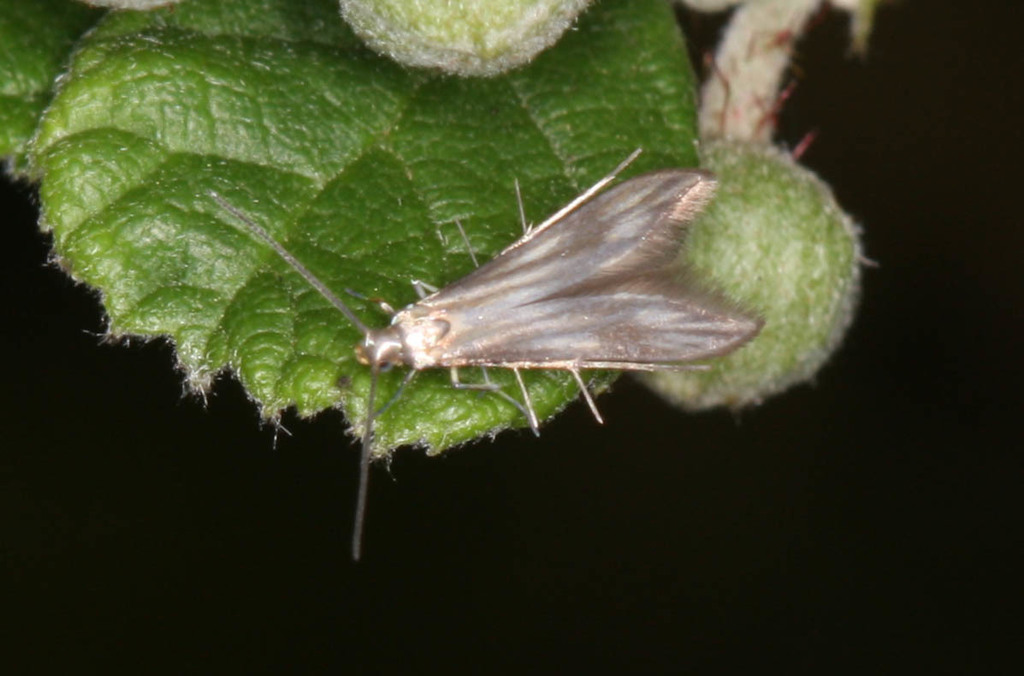
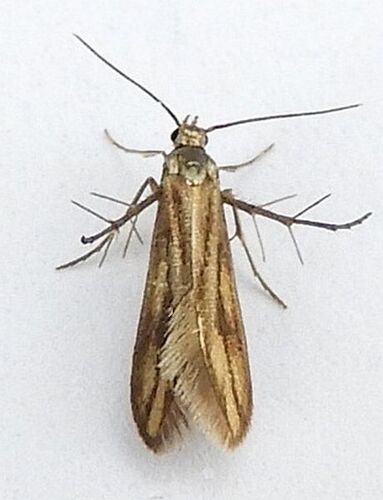
The blackberry skeletonizer is a tiny moth with a wingspan of about 10 to 12 mm and distinctive pale metallic bronzy-ochreous head and ochreous forewings marked with dark fuscous streaks. It breeds on bramble and raspberry leaves, laying single eggs on leaf margins or petioles, and produces two or three generations from March through September.
Source: Wikipedia
How to recognize it
Hindwings are dark grey.
Source: Wikipedia
Size
The moth’s wingspan measures 10 to 12 mm.
Source: Wikipedia
Life cycle
There are two or three generations per year, with adults flying from March to September. The pupa starts green, darkens through several colour changes, and becomes iridescent inside an open network cocoon attached low on a stem.
Source: Wikipedia
When you see it
Adults are on the wing from early spring through late summer (March to September).
Source: Wikipedia
Where it comes from
Originally Palearctic, the species now occurs across much of North America.
Source: Wikipedia
Where it is found in the US
Recorded in 21 of 51 states and DC. Most records: California, Pennsylvania, New York, Hawaii, Washington, Massachusetts, Alaska, Vermont.
Darker = more records. Counts are museum and citizen-science records, not population size.
Source: GBIF
Status: native in North America; native in Canada. Source: iNaturalist
Months it is reported in the US
Source: GBIF
More photos
Questions people ask
When are adult blackberry skeletonizers active?
Adults are on the wing from March through September.
Source: Wikipedia
What plants do they lay their eggs on?
Eggs are laid singly on the leaf margins or petioles of bramble and raspberry.
Source: Wikipedia
Where is this moth found?
It is native to the Palearctic and now widespread across North America from the west coast to the east coast and into Canada.
Source: Wikipedia
How many generations does it have each year?
It produces two or three generations annually.
Source: Wikipedia
Same family (Schreckensteiniidae)

Sources
- Wikipedia: https://en.wikipedia.org/wiki/Schreckensteinia_festaliella
Look it up elsewhere: GBIF · iNaturalist · BugGuide · ITIS · Wikipedia
Text written 2026-10-26 from the sources above and checked sentence by sentence against them. Data fetched 2026-10-26.