 Bug FAQ
Bird-cherry Ermine
Yponomeuta evonymella · Order: Lepidoptera · Family: Yponomeutidae
Source: Wikipedia
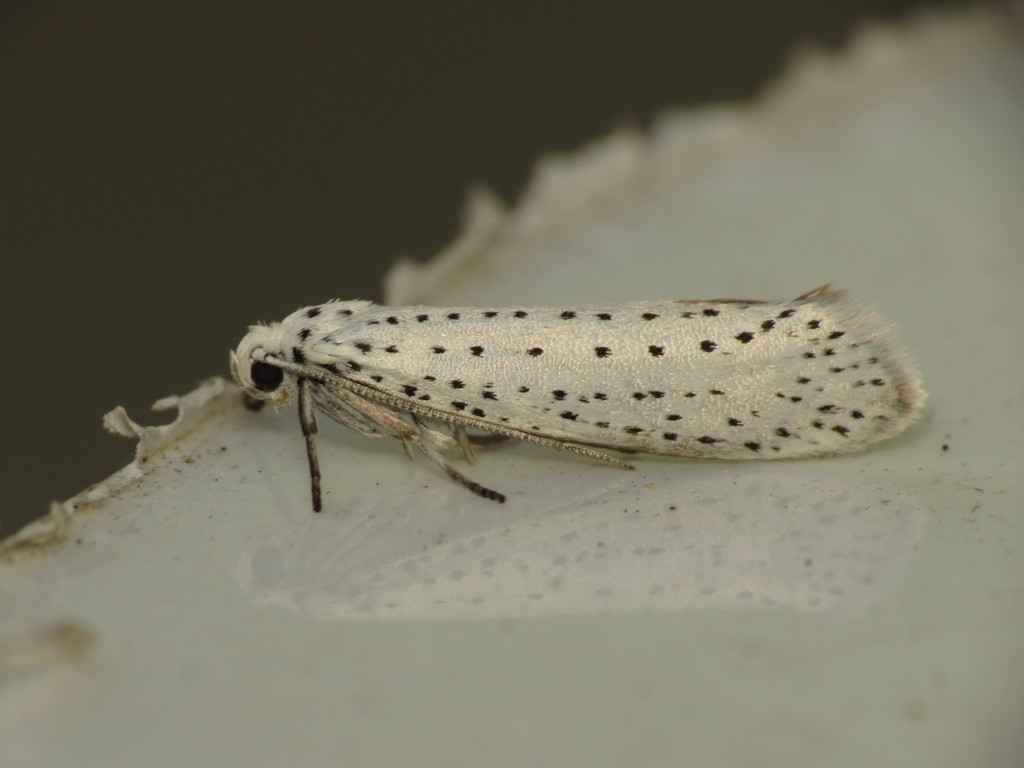
Adult moths have a wingspan of about 16 to 25 mm and are white with black spots on the forewings and smoky brown hindwings. They fly at night from July to August, lay eggs on winter buds, and the larvae feed on bird-cherry leaves before pupating in early summer. The species occurs across most of Europe and parts of northern and eastern Asia, in forests, stream banks, gardens and parks.
Source: Wikipedia
How to recognize it
The forewings are white with five rows of small black spots. The hindwings are smoky brown with a dark edge.
Source: Wikipedia
Size
Wingspan ranges from 16 to 25 mm (about 0.6 to 1.0 in).
Source: Wikipedia
What it eats
Caterpillars mainly feed on bird-cherry, but can also use cherry or buckthorn.
Source: Wikipedia
Life cycle
Females lay eggs on winter buds. Young caterpillars overwinter under bud scales and become active when buds open in spring. Larvae feed until late May or early June, then pupate.
Source: Wikipedia
When you see it
Adults are on the wing from July to August.
Source: Wikipedia
Where it comes from
Its range covers almost all of Europe and the northern and eastern parts of Asia.
Source: Wikipedia
Lookalikes
Similar destructive moths include the cherry or orchard ermine (Yponomeuta padella) and the apple ermine (Yponomeuta malinellus).
Source: Wikipedia
Questions people ask
Can they damage my garden plants?
Yes, their larvae feed on bird-cherry and occasionally on cherry or buckthorn, which can harm those trees.
Source: Wikipedia
When are they active?
Adults fly at night from July through August, while larvae are present from spring until early June.
Source: Wikipedia
Sources
- Wikipedia: https://en.wikipedia.org/wiki/Bird-cherry_ermine
Look it up elsewhere: GBIF · iNaturalist · BugGuide · Wikipedia
Text written 2026-10-22 from the sources above and checked sentence by sentence against them. Data fetched 2026-10-22.