 Bug FAQ
Birch Shield Bug
Elasmostethus interstinctus · Order: Hemiptera · Family: Acanthosomatidae
Also called: Birch Shieldbug
Source: Wikipedia

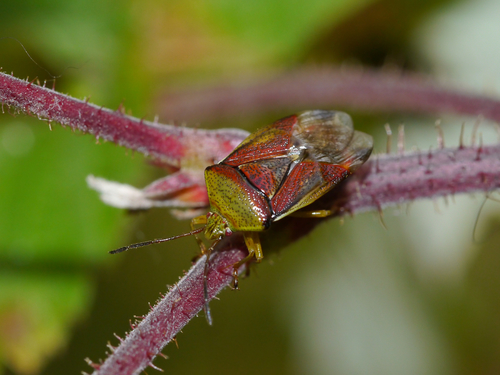
The Birch Shield Bug is 8 to 11.5 mm long and has a flat, black-punctured body with bright yellow-green and red markings. It lives in sunny birch woodlands and other mixed deciduous areas across Europe, northern Asia and North America. Adults overwinter in leaf litter, emerge in spring to mate, and lay eggs on birch leaves and catkins from early June to mid-August.
Source: Wikipedia
How to recognize it
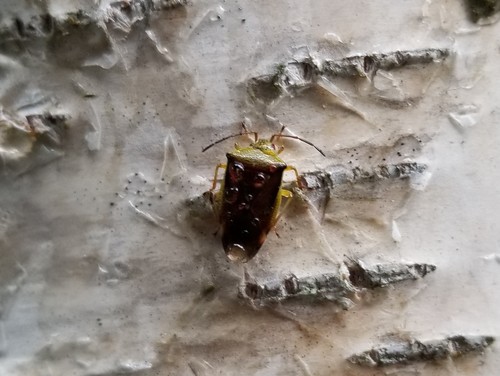
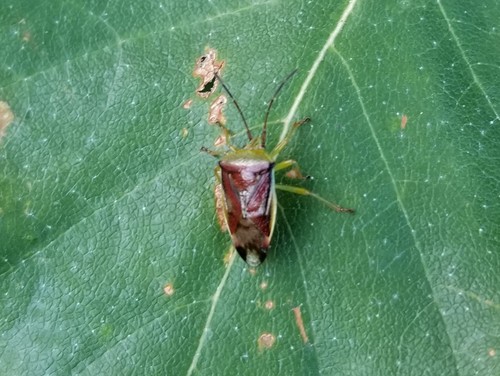
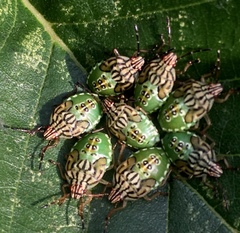
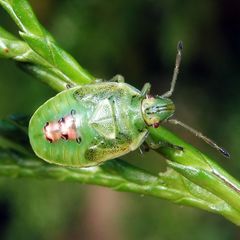
The bug’s upper side is covered with black punctures and shows bright yellow-green coloration with red spots.
Source: Wikipedia
Size
Adults measure about 8 to 11.5 mm in length.
Source: Wikipedia
Where it lives
It prefers sunny spots in mixed birch woodlands, deciduous trees and shrubs.
Source: Wikipedia
What it eats
Larvae mainly feed on birch but can also use aspen and hazel. Adults have been recorded on juniper, oak, holly, blueberry, alder, beech and poplar.
Source: Wikipedia
Life cycle
Adults spend the winter in leaf litter and become active in spring to mate.
Source: Wikipedia
When you see it
Egg-laying occurs from early June through mid-August.
Source: Wikipedia
Where it comes from
The species is common throughout the Holarctic, found in Europe, northern Asia (except China) and North America.
Source: Wikipedia
Lookalikes
It can be mistaken for the larger, more elongate Hawthorn Shield Bug, which has smaller lateral pronotum extensions.
Source: Wikipedia
Where it is found in the US
Recorded in 2 of 51 states and DC. Most records: Alaska, Washington.
Darker = more records. Counts are museum and citizen-science records, not population size.
Source: GBIF
Status: native in North America; native in Canada. Source: iNaturalist
Months it is reported in the US
Source: GBIF
More photos

Questions people ask
Are they a problem for my garden?
Their larvae feed on birch and related trees, so they can damage those plants in gardens and forests.
Source: Wikipedia
When will I see them?
Adults are most noticeable from early June to mid-August when they lay eggs on birch leaves and catkins.
Source: Wikipedia
Same family (Acanthosomatidae)


Sources
- Wikipedia: https://en.wikipedia.org/wiki/Elasmostethus_interstinctus
Look it up elsewhere: GBIF · iNaturalist · BugGuide · ITIS · Wikipedia
Text written 2026-10-22 from the sources above and checked sentence by sentence against them. Data fetched 2026-10-22.