 Bug FAQ
American Grass Mantis
Thesprotia graminis · Order: Mantodea · Family: Thespidae
Also called: Grass-like Mantid
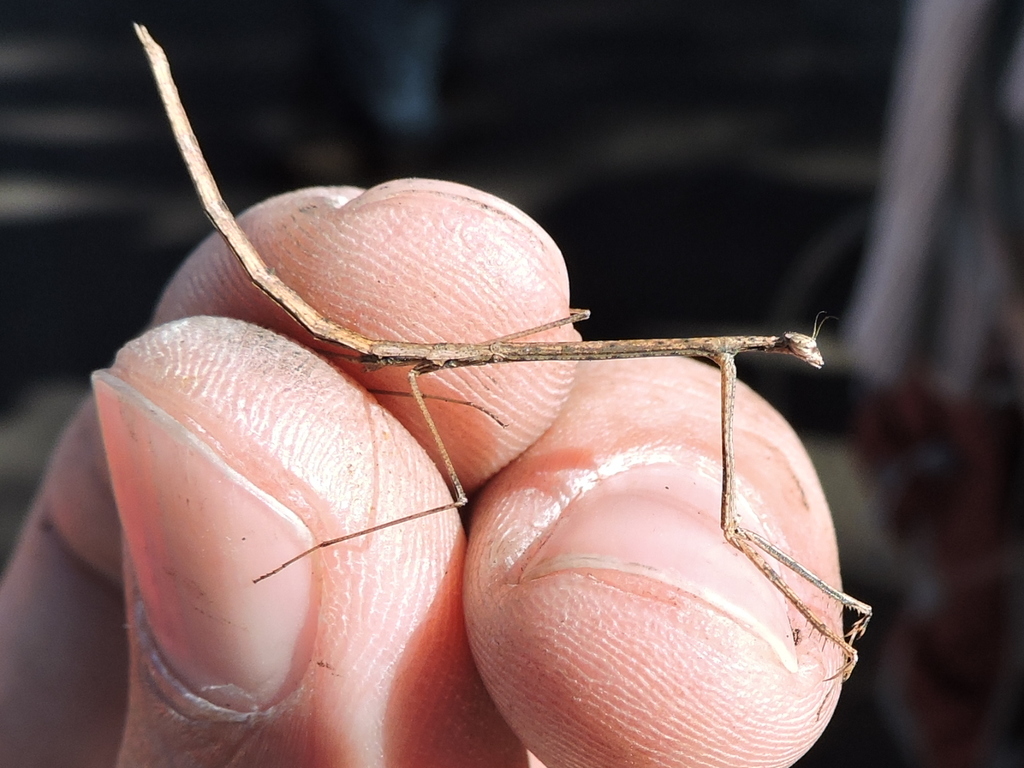
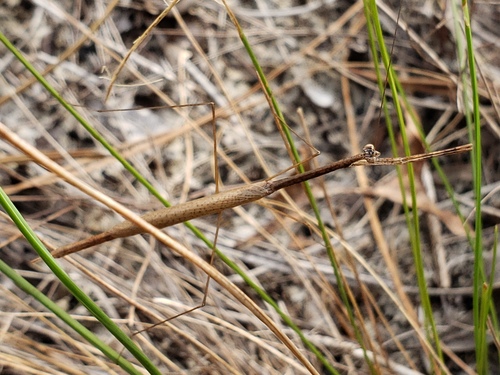
The American grass mantis is a medium-sized mantid, usually 47 to 56 mm long but can exceed 60 mm. It lives in many Southern U.S. habitats such as grasslands, pine stands, thickets and areas with Spanish moss, where its needle-like shape provides camouflage. Adults eat flies, moths and other small insects, and they develop through egg, nymph and adult stages like other mantids.
Source: Wikipedia
How to recognize it
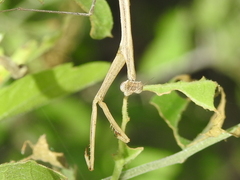
It has a triangular head with tiny black spots above the eyes that end in two upward points, and each foreleg bears a single large dorsal spine.
Source: Wikipedia
Size
Adults are typically 47 to 56 mm long, though some individuals can be larger. A specimen from Punta Gorda, Florida measured 60.5 mm.
Source: Wikipedia
Where it lives
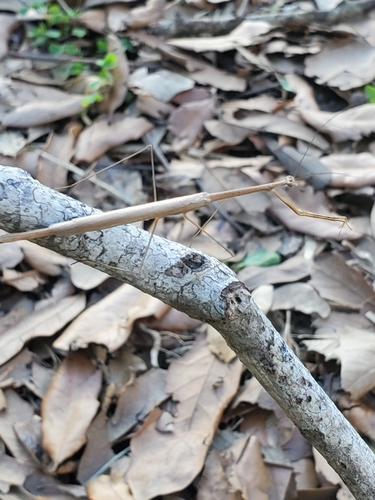
It occurs in grasslands, pine stands, thickets and among Spanish moss. Its needle-like appearance lets it blend well where pine needles dominate the ground cover.
Source: Wikipedia
What it eats
It preys on flies, moths, other small insects and occasionally other mantids. Adults readily take large flies or small-to-medium moths.
Source: Wikipedia
Life cycle
Like other mantids, it undergoes hemimetabolous development: egg, nymph, then adult. Recent studies have added details to its reproductive ecology.
Source: Wikipedia
Where it comes from
The species is native to the Southern United States.
Source: Wikipedia
Lookalikes
It resembles the light-brown Brunneria borealis.
Source: Wikipedia
Where it is found in the US
Recorded in 10 of 51 states and DC. Most records: Florida, Texas, Georgia, Louisiana, Alabama, Mississippi, South Carolina, New York.
Darker = more records. Counts are museum and citizen-science records, not population size.
Source: GBIF
Status: native in North America; native in United States. Source: iNaturalist
Months it is reported in the US
Source: GBIF
More photos
Questions people ask
How can I identify an American grass mantis?
Look for a triangular head with tiny black spots above the eyes that end in two upward points, and a single large dorsal spine on each foreleg.
Source: Wikipedia
How big does this mantis get?
Adults are usually 47 to 56 mm long, but some can be larger, with one measured at 60.5 mm.
Source: Wikipedia
Where does the American grass mantis live?
It inhabits grasslands, pine stands, thickets and areas with Spanish moss across several Southern states.
Source: Wikipedia
What does it eat?
It feeds on flies, moths, other small insects and sometimes other mantids.
Source: Wikipedia
Same family (Thespidae)
Sources
- Wikipedia: https://en.wikipedia.org/wiki/Thesprotia_graminis
Look it up elsewhere: GBIF · iNaturalist · BugGuide · ITIS · Wikipedia
Text written 2026-10-23 from the sources above and checked sentence by sentence against them. Data fetched 2026-10-22.