 Bug FAQ
Algidia chiltoni
Algidia chiltoni · Order: Opiliones · Family: Triaenonychidae
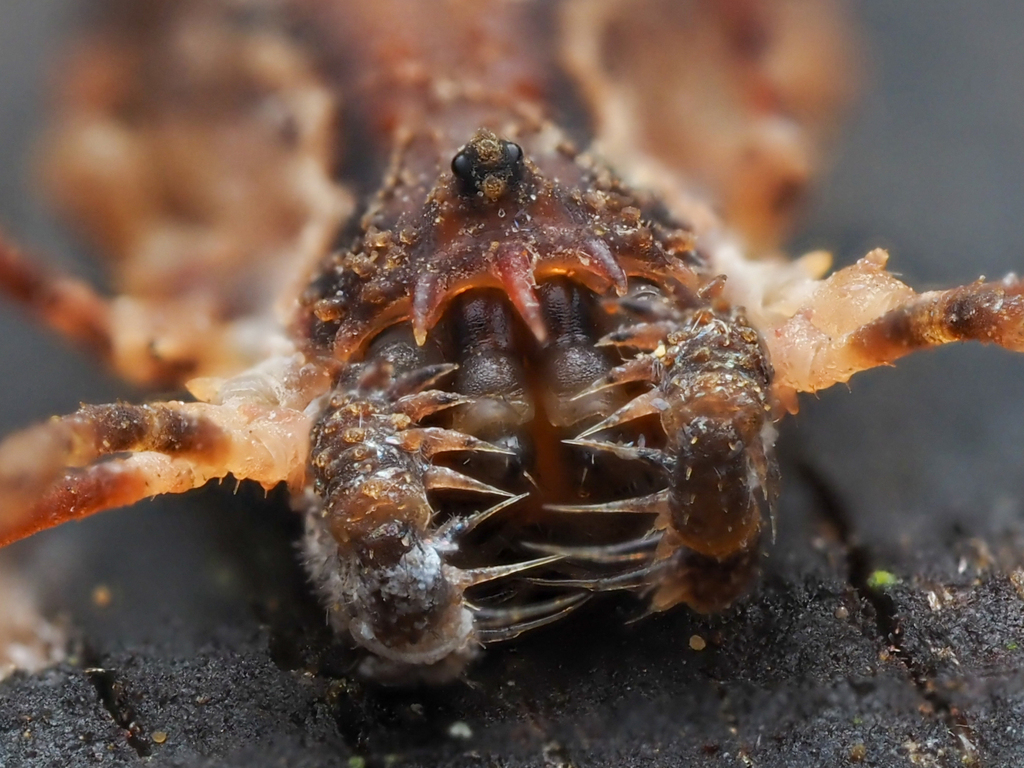
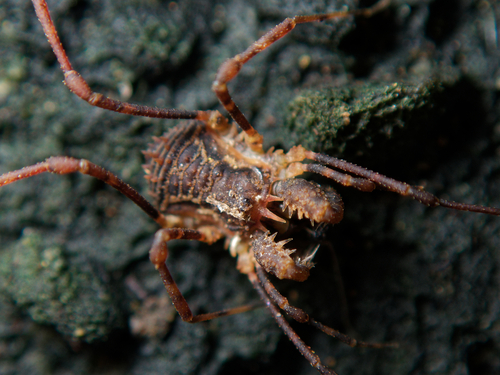
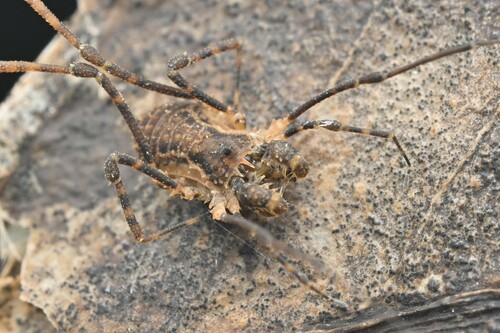
Males can be told apart by the number and length of tubercles on the eye mound and by a swelling on the male pedipalp femur that has a spinous tubercle. It looks most like the subspecies A. c. longispinosa and A. c. oconnori, but its dorsal tubercles are shorter and its ventral tubercles are both shorter and fewer.
Source: Wikipedia
How to recognize it
The eye-mound tubercles of male A. c. chiltoni are shorter and more numerous than those of A. c. longispinosa, but shorter and fewer than those of A. c. oconnori. Male pedipalps have a dorsal swelling on the femur with a spinous tubercle, a feature shared with A. c. longispinosa but absent in A. c. oconnori.
Source: Wikipedia
Lookalikes
It resembles other Algidia subspecies, especially A. c. longispinosa and A. c. oconnori, but can be distinguished by its shorter dorsal tubercles and fewer, shorter ventral tubercles.
Source: Wikipedia
More photos
Questions people ask
How can I tell male Algidia chiltoni apart from similar subspecies?
Look at the eye-mound tubercles: they are shorter and more numerous than in A. c. longispinosa but shorter and fewer than in A. c. oconnori, and check for a dorsal swelling with a spinous tubercle on the male pedipalp femur.
Source: Wikipedia
Sources
- Wikipedia: https://en.wikipedia.org/wiki/Algidia_chiltoni
Look it up elsewhere: GBIF · iNaturalist · BugGuide · ITIS · Wikipedia
Text written 2026-10-24 from the sources above and checked sentence by sentence against them. Data fetched 2026-10-23.