 Bug FAQ
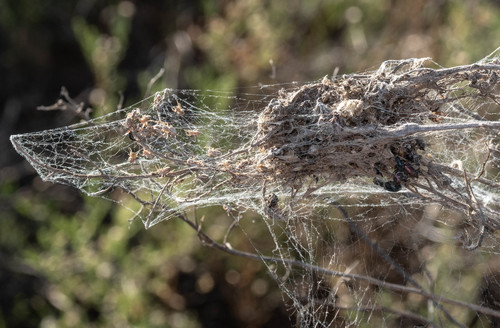
African Social Spider
Stegodyphus dumicola · Order: Araneae · Family: Eresidae
Also called: Common Community Nest Spider, Common Social Nestspider

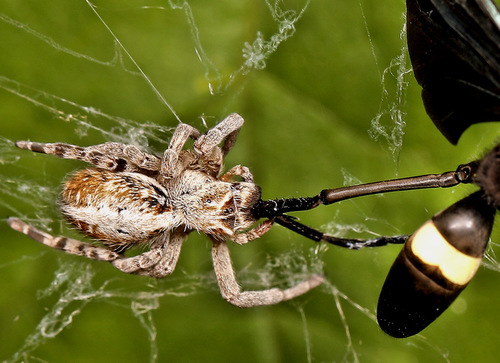
These spiders are tiny, about 2.3 to 3.5 mm long, have a tough carapace with white hairs, and show sex-specific abdominal markings, males with dark borders and narrow white bands, females with dark longitudinal bands. They live in mesic to semi-arid woodlands of Namibia’s thornbush country, but not the Namib Desert, and are native to central and southern Africa. Colonies last about a year, females live longer than males, mature in the early summer, lay eggs February-March, and larger members help capture prey which is shared with spiderlings.
Source: Wikipedia
Size
Adults measure between 2.3 and 3.5 mm in length.
Source: Wikipedia
What it eats
Larger spiders take part in cooperative prey capture, and females feed second-stage spiderlings by regurgitating a nourishing fluid after catching prey.
Source: Wikipedia
Life cycle
A generation lives about one year, with males having shorter lifespans than females.
Source: Wikipedia
When you see it
Mating finishes from January to March; Namibian females mature from January into mid-summer and lay eggs February to March.
Source: Wikipedia
Where it comes from
The species is native to central and southern Africa.
Source: Wikipedia
Lookalikes
It is one of three social Stegodyphus species, the others being S. lineatus and S. mimosarum.
Source: Wikipedia
More photos
Questions people ask
How can I identify an African social spider?
Look for a tiny spider (2.3 to 3.5 mm) with a tough, white-haired carapace; males show dark borders and narrow white bands on the abdomen, females have dark longitudinal bands.
Source: Wikipedia
When do these spiders reproduce?
Females mature from January into mid-summer and lay eggs between February and March, with the mating season ending by March.
Source: Wikipedia
Sources
- Wikipedia: https://en.wikipedia.org/wiki/Stegodyphus_dumicola
Look it up elsewhere: GBIF · iNaturalist · BugGuide · ITIS · Wikipedia
Text written 2026-10-23 from the sources above and checked sentence by sentence against them. Data fetched 2026-10-23.